
We are living and leading through a period in which many assumptions we have relied on are being challenged. Technology is developing at extraordinary speed, geopolitical conditions are shifting, business models are being disrupted, and expectations on leaders and boards continue to grow. Yet much of our thinking about leadership still rests on an old assumption: the leader should know.
This is the starting point for Beyond the Old Playbook, a new nine-part Digoshen Exploring Leaders podcast series exploring how we lead, navigate and govern when certainty is no longer available. The series moves between three interconnected perspectives: Leading Through Uncertainty, Navigating Change and Governing for Renewal, with art used throughout as a way to open questions and challenge familiar ways of seeing.
Navigating without certainty
In the opening episode, What If the Problem Is Our Need for Certainty?, we speak with Lidija Drobež, an executive coach with more than 25 years of international leadership experience, about navigating change when the way ahead cannot be fully known.
The conversation begins with Caspar David Friedrich’s Wanderer above the Sea of Fog (1818): a solitary figure has climbed high enough to gain perspective, yet much of the landscape and the road ahead remain hidden.

It is a powerful image for leadership today. We reward expertise, confidence and decisiveness, and organisations need direction, plans and good analysis. But problems arise when the desire for certainty becomes stronger than our willingness to see reality as it is. In genuinely uncertain situations, more analysis does not necessarily produce certainty. Forecasts can be wrong, strategies can rest on assumptions that are already changing, and experience can tempt us to interpret something genuinely new through patterns from the past.
Recent INSEAD research provides an interesting perspective on this. In Leading Organisational Change Without a Roadmap, Chengyi Lin and Michael Y. Lee followed an organisational transformation over five years. They distinguish between technical problems, where established solutions and detailed plans can work, and adaptive challenges, where the solution cannot be fully known in advance. The research suggests that leaders sometimes need to move before the full roadmap exists—creating direction, taking initial steps, learning from what happens and adjusting along the way.
From certainty to orientation
The challenge, then, is not to abandon analysis or planning, but to understand when they have reached their limits. It also places greater value on the ability to pause and notice before interpreting. Slowing down can create space for weak signals, alternative perspectives and information that does not fit our existing assumptions. This is one reason art is part of Beyond the Old Playbook. Looking at an artwork invites us to stay with observation a little longer and ask: What do I see? What am I not seeing? What else could this be?

In a recent Harvard Business Review article, Simone Stolzoff argues that leaders need to develop tolerance for uncertainty as a core capability. Rather than trying to eliminate uncertainty, leaders can become better at operating within it—anchoring themselves in enduring values and priorities while remaining open to what is changing around them.
Perhaps what replaces certainty, then, is not ambiguity but orientation. Leaders may not know exactly where an organisation will be three years from now while still being clear about purpose and strategic intent. Boards may not know exactly how AI will reshape their industry while still being able to question assumptions and identify emerging vulnerabilities and opportunities.
This requires judgement, curiosity and humility—the ability to hold a point of view while remaining prepared to change it as reality changes. Stanford’s John Hennessy and Tina Seelig have similarly highlighted curiosity, empathy and humility as important capabilities for leadership in complex situations.
Perhaps this is a more useful form of confidence for uncertain times: not confidence that I know what will happen, but confidence that we can observe, learn, decide and adjust as it does.
Friedrich’s wanderer has reached a place from which he can see further, but the fog has not disappeared. Perhaps leadership is not about clearing the fog, but becoming better at navigating within it.
What might you notice if you stopped trying to find the answer quite so quickly?
Listen to the conversation
In the first episode of Beyond the Old Playbook, Liselotte Engstam speaks with Lidija Drobež about what it means to navigate when certainty is unavailable—and what becomes possible when we shift from seeking answers to finding our bearings.
Listen to What If the Problem Is Our Need for Certainty?
On Youtube
Lidija Drobež, executive coach, shares how leaders can discover new ways to navigate uncertainty.
Lidija Drobež, executive coach and facilitator, explores why our need for certainty may be limiting our ability to lead in times of change. Drawing on leadership practice, philosophy, and art, she examines how judgment, curiosity, adaptability, and values can help us move forward when prediction and control are no longer enough.
.
.
.
.
On Spotify
Lidija Drobež, executive coach, shares how leaders can move beyond control and discover new ways to navigate uncertainty.
Listen to this episode from Exploring Leaders by Digoshen on Spotify. Lidija Drobež, executive coach and facilitator, explores why our need for certainty may be limiting our ability to lead in times of change. Drawing on leadership practice, philosophy, and art, she examines how judgment, curiosity, adaptability, and values can help us move forward when prediction and control are no longer enough.
.
.
.
.
.
A conversation with Lidija Drobež

Lidija Drobež combines international leadership experience, executive coaching, and the arts. After a successful corporate career, she has spent more than 25 years supporting leaders and organizations through change, uncertainty, and reinvention.
As founder of Galleria l’arte di seta and a Fellow of the Institute of Coaching at Harvard Medical School, she integrates coaching, creativity, and reflective practice to help leaders expand their perspectives and discover new possibilities. Connect with Lidija Drobez at Linkedin
.
Explore further
INSEAD Knowledge — Leading Organisational Change Without a Roadmap
Chengyi Lin and Michael Y. Lee shares a five-year study of organisational transformation showing how leaders can move forward when there is no proven playbook, complete roadmap or guarantee of success. Read the INSEAD article
Harvard Business Review — Leaders, It’s Time to Build Your Tolerance for Uncertainty
Simone Stolzoff, 13 January 2026. An exploration of uncertainty tolerance as a leadership capability—and how leaders can anchor themselves in enduring priorities rather than trying to eliminate uncertainty. Read the HBR article
Stanford — Why Curiosity, Empathy, and Humility Matter in Leadership
Tina Seelig and John Hennessy on curiosity, humility and open-ended questioning as leadership capabilities. Read the Stanford article
More about Friedrich Caspar and his paintings 5 min at Youtube by The Canvas
From exploring to experiencing
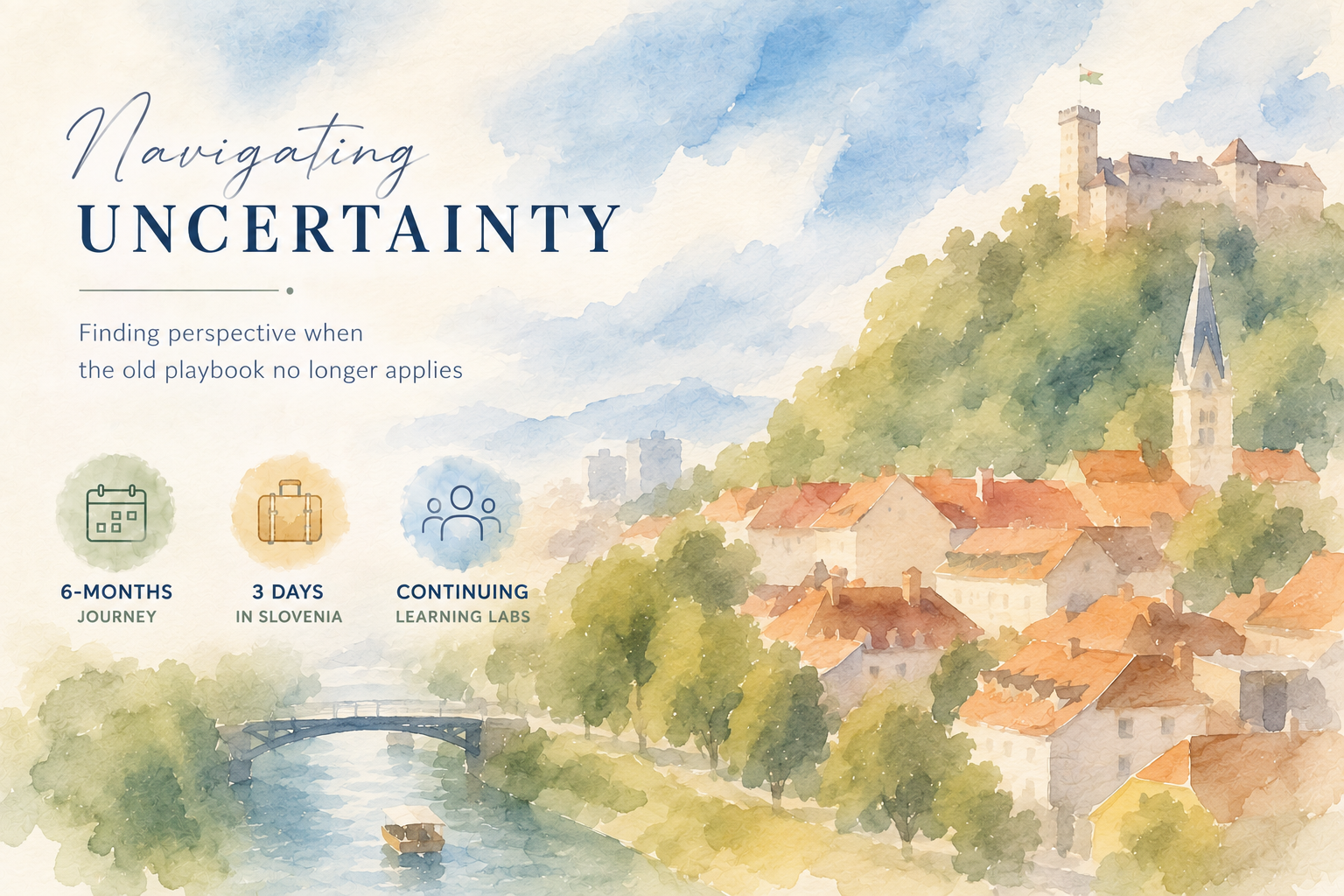
If these questions resonate, Navigating Uncertainty offers an opportunity to explore them more deeply. This six-month executive learning journey combines coaching, dialogue, art, place and reflection to strengthen four distinctly human capabilities for uncertain environments: seeing, reframing, adapting and renewing.
Explore Navigating Uncertainty and the 2026–2027 cohort
About Digoshen

This blog post was originally published on the Digoshen blog and the personal blog of Digoshen founder Liselotte Engstam.
At Digoshen, we help leaders and boards navigate an increasingly complex world shaped by AI, digital transformation, sustainability, geopolitical change, and evolving workforce dynamics.
Through research, executive education, thought leadership, coaching, and international networks, we translate emerging trends into practical insights that strengthen leadership, governance, innovation, and long-term value creation. We believe that the future belongs to organizations that successfully combine technological intelligence with human wisdom.
If you are a board member, executive, or leader interested in shaping the future of your organization, we invite you to explore our articles, research, podcasts, learning programs, and international communities.
You are also welcome to discover the Boards Impact Forum, chaired by Digoshen founder Liselotte Engstam, and Novisali, her artistic practice exploring leadership, reflection, and human experience through art.
Find more insights on the Digoshen website, explore Liselotte Engstam’s research on Google Scholar, and follow Digoshen on LinkedIn.