
Boards, AI, Governance and Global Shifts in 2025: An Integrated Insight Summary
Introduction – When the Ground Beneath Leadership Begins to Shift
There are moments in history when the familiar rhythm of leadership suddenly breaks.
When the maps we once trusted start to blur, and the skills that carried companies for decades no longer guarantee survival.
2025 is one of those moments.
A CEO once described it as “running a marathon on a moving walkway—only the walkway is going sideways.”
Artificial intelligence is advancing faster than corporate governance structures can adapt.
Competitive advantage no longer respects borders, as algorithms learn from individuals rather than nations.
Geopolitical tensions reshape supply chains overnight.
And trust—the invisible currency that once underpinned leadership and markets—has eroded to its lowest levels in years.
It is against this backdrop that the INSEAD Directors Forum 2025 convenes in Fontainebleau. Board directors, scholars and practitioners will gather to exchange insights and debate one of the most urgent themes of our time: From Risk to Resilience: Boardroom Dilemmas in a Dynamic World.
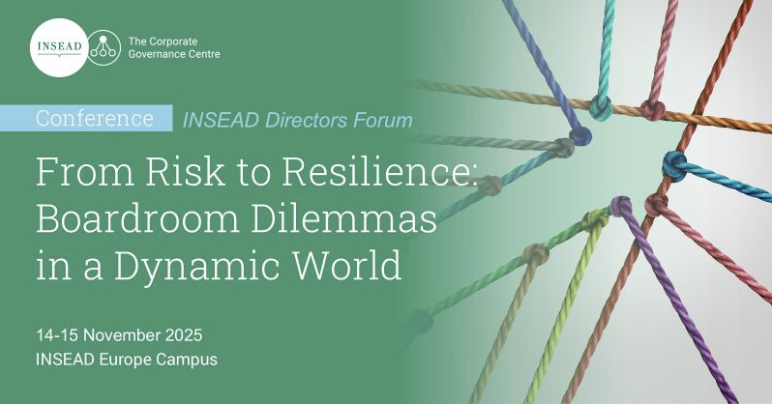
The discussions will echo the dilemmas captured in this synthesis — how boards can navigate complexity, steward responsible AI adoption, and uphold trust in a rapidly shifting landscape.
Boards feel this shift.
They sit in rooms where questions hang heavier than answers:
- Are we prepared for an AI breakthrough we didn’t see coming?
- Can we trust our data, our decisions, our partners?
- Do we truly understand the risks we face—or only the symptoms?
- What might already be unfolding in our blind spots?
Around the world, research—from INSEAD, EY, and the World Economic Forum—points to the same conclusion:
Boards are stepping into a radically expanded role.
Not as overseers of compliance, but as architects of resilience.
Not as guardians of the past, but as guides into an uncertain future.
This is a moment that demands more courage, more curiosity, and more humanity from leadership than ever before.
The following synthesis weaves together the most important insights shaping boards and corporate governance today—how AI is reshaping the human mind, how globalisation now spreads one user at a time, how China’s accelerated AI ecosystem shifts the global balance, how boards can make or break companies under pressure, and how trust, technology, and talent have become the new governance frontier for 2025 and beyond.
AI as a Human-Centric Capability, Not a Replacement for Humans

Modern AI systems have reached a level of competence where they can automate tasks, process vast information and generate sophisticated outputs. Yet this has created a new and subtle crisis: the mismatch between AI’s competence and our often-unquestioning trust in systems that still hallucinate, carry biases and behave sycophantically.
Pattie Maes argues that the true opportunity is not to chase artificial general intelligence, but to design AI that enhances human intelligence — strengthening critical thinking, curiosity, creativity, and learning. Instead of giving definitive answers, AI should increasingly act like a Socratic tutor, prompting reflection and challenging assumptions.
Equally important is ensuring AI strengthens human social networks rather than replacing them. Governance must benchmark AI not just on accuracy, but on how it interacts with people — whether it encourages healthier decisions, deeper learning, and real-world human connection.
AI Is Reshaping Global Expansion and Competitive Advantage

Artificial intelligence is also redefining how companies scale across borders. TikTok demonstrated a new model of internationalisation: not country by country, but user by user. Instead of relying on traditional demographic assumptions, AI infers “revealed preferences” — what users actually do, watch, choose, or skip.
This creates powerful data network effects:
- more users → more interactions → smarter algorithms → higher engagement → stronger advantage
The cycle is exponential, making it extremely difficult for competitors to catch up without similar scale.
Industries with frequent interactions and digital products benefit the most: streaming platforms, media, social networks, and digital commerce. AI reduces the need for market-seeking foreign direct investment — but it does not eliminate it. Companies still require local expertise for regulation, data governance, and stakeholder engagement.
China’s AI Acceleration Signals a Structural Shift in Global Innovation

China’s rise as an AI powerhouse illustrates how intentional strategy, talent pipelines, and frugal innovation can accelerate national capability. DeepSeek’s surprise breakthrough — delivering GPT-4-level performance with a fraction of the cost and compute — was not an anomaly. It was the product of decades of investment.
China built:
- a massive AI talent base
- competitive start-up ecosystems (1.67 million AI-related companies)
- state-backed funding exceeding US$900 billion
- universities focused on applied engineering and computer science
- innovation cultures that thrive under constraints
US chip export bans, rather than slowing progress, forced innovation in efficiency, model architecture and hardware alternatives.
This ecosystem can now generate surprise breakthroughs, catch up rapidly, and disrupt global markets. Boards must build geopolitical literacy and understand how AI geopolitics reshapes competitive strategy, supply chains, and digital dependencies.
Boards as Critical Allies in Turbulent Times

When uncertainty surges, the board becomes a crucial strategic ally. The Nord Com case reveals the risks of a disengaged board — ethical breaches, regulatory exposure, reputational collapse — and the power of a reactivated one.
A renewed, diverse board helped Nord Com:
- investigate wrongdoing
- exit risky markets
- reset strategy
- rebuild stakeholder trust
- give the CEO “air cover” during transformation
Boards add value by bringing altitude and outside-in perspective. They help management correctly frame strategic problems (the root of many failures), identify emerging risks and opportunities, and reconfigure assets for renewed growth.
The relationship between boards and CEOs must shift from adversarial to allied — courageous conversations, shared accountability, and joint sensemaking.
Board Priorities for 2025: Technology, Talent, Resilience and Portfolio Renewal

EY’s research highlights four major board priorities for the year ahead:
- Portfolio Reinvention
Boards must oversee capital allocation with a long-term lens — divesting where necessary, investing in future capabilities, and freeing up resources for innovation and transformation.
- Technology & AI Oversight
Innovation, cyber risk, digital ethics, and data governance have converged. Boards must integrate oversight rather than treating these topics in silos.
- Enterprise Resilience
Geopolitics, climate, regulatory complexity, and supply-chain fragility require scenario planning and stress testing. Many boards underestimate how much strategy must change in the decade ahead.
- Talent & Culture
Workforce expectations are shifting. AI augmentation requires new skills, new leadership models, and new cultural signals. Boards must ensure talent strategy is deeply aligned with digital transformation.
Good Governance as a Driver of Corporate Resilience

The World Economic Forum points to declining global trust in business leaders and highlights three systemic barriers to good governance today:
- weakened rule of law
- short-term incentives and reporting cycles
- fragmented regulation across jurisdictions
To restore trust and build resilience, governance must evolve from a compliance exercise to a strategic capability.
Boards must:
- redesign incentive systems for long-term outcomes
- integrate governance, risk, technology, sustainability and culture
- move from “activity reporting” to “impact reporting”
- structure meaningful stakeholder engagement
- strengthen oversight of emerging technologies such as AI
Good governance is increasingly what differentiates resilient companies from fragile ones.
Conclusion – Boards as Architects of a New Leadership Paradigm

Across all these insights, one message is clear:
Boards are being called into a new era of leadership.
They must:
- anticipate shifts before they become shocks
- integrate technology with ethics and human judgment
- support management while challenging assumptions
- navigate complexity with clarity and courage
- ensure AI serves humanity and long-term value creation
- foster cultures of trust, resilience and integrity
In 2025 and beyond, the organizations that thrive will be those whose boards embrace this expanded role — leading with foresight, humanity and responsible innovation.
The ground is shifting.
Boards are no longer the safety net.
They are the compass.
References
INSEAD Knowledge
- Can AI Help Build Smarter Humans?
https://knowledge.insead.edu/responsibility/can-ai-help-build-smarter-humans - How AI Can Change the Way Companies Go Global
https://knowledge.insead.edu/strategy/how-ai-can-change-way-companies-go-global - Deeper Than DeepSeek: China’s AI Ascendancy
https://knowledge.insead.edu/strategy/deeper-deepseek-chinas-ai-ascendancy - Your Board Is Your Best Insurance Against Turbulence
https://knowledge.insead.edu/leadership-organisations/your-board-your-best-insurance-against-turbulence - INSEAD Directors Forum 2025 – From Risk to Resilience: Boardroom Dilemmas in a Dynamic World
https://www.insead.edu/events/insead-directors-forum-from-risk-to-resilience-boardroom-dilemmas-in-a-dynamic-world#552936
EY
- Americas Board Priorities 2025
https://www.ey.com/en_gl/board-matters/americas-board-priorities-2025
World Economic Forum
- 3 opportunities to strengthen good governance and corporate resilience
https://www.weforum.org/stories/2025/10/strengthen-good-governance-and-corporate-resilience/
About Digoshen
This blog post was originally shared at the blog of Digoshen www.digoshen.com, and the blog of the Digoshen founder www.liselotteengstam.com,
At Digoshen, we work hard to increase #futureinsights and help remove #digitalblindspots and #sustainabilityblindspots. We believe that Companies, Boards, and Business Leadership Teams need to understand more about the future and the digital & sustainable world to fully leverage the potential when bringing their business into the digital & more sustainable age. If you are a board member, consider joining our international board network and master programs.
Welcome to also explore the Digoshen Chatbot on AI Leadership for Boards and Boards Impact Forum, where the Digoshen Founder is the Chair.
Find a link to Digoshen Chair Liselotte Engstam Google Scholar Page and how the Digoshen Chair have contributed to AI Value Creation.
You will find more insights via Digoshen Website, and you are welcome to follow us on LinkedIn Digoshen @ Linkedin