
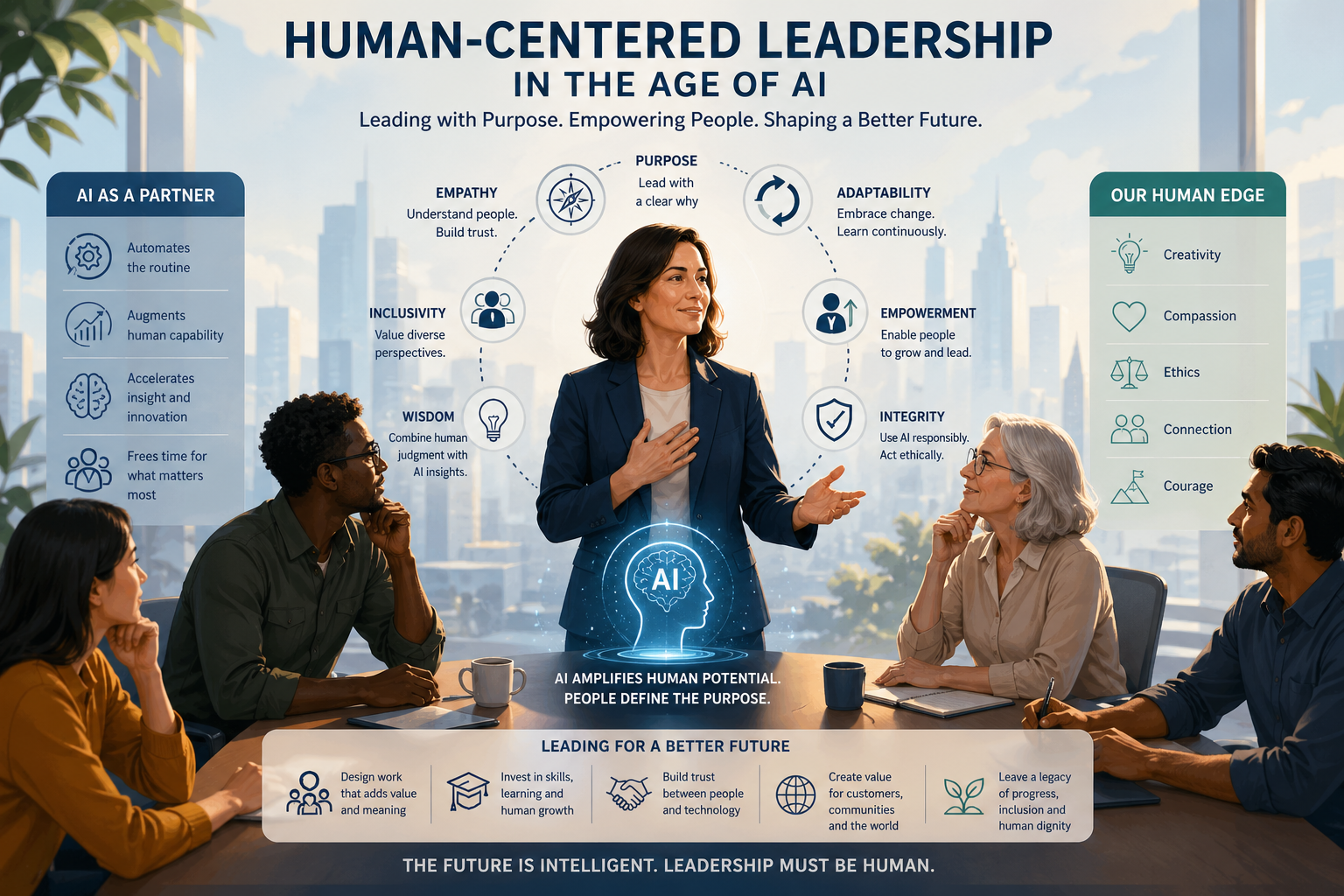
Artificial intelligence is entering a new phase. It is no longer simply a tool for efficiency, automation, or experimentation. It is becoming a structural force that is changing how organizations operate, how value is created, how people develop skills, and how leaders guide transformation. Many organizations still speak about AI as if it were another software upgrade. In reality, it is closer to a redesign of the modern enterprise.
The most important misunderstanding about AI is the belief that its primary impact will be job destruction. Some roles will certainly disappear, and many tasks will be automated. But the larger and more immediate reality is that work itself is being reconfigured. Occupations may remain, yet the content of those occupations can shift dramatically. Jobs once defined by routine expertise may become centered on judgment, relationship management, creative problem-solving, or oversight of intelligent systems. What changes first is often not the job title, but the nature of the work.
This means the central challenge for organizations is not simply workforce reduction. It is workforce transition.
For decades, companies were designed around a familiar model: hire people into defined roles, optimize processes, supervise execution, and improve productivity incrementally. AI disrupts each element of that model. Roles become fluid as tasks are redistributed between humans and machines. Processes become adaptive rather than fixed. Supervision shifts toward orchestration. Productivity can improve non-linearly when intelligence is embedded directly into workflows.
As a result, many organizations are discovering that the old structure remains in place while new technological capability has arrived. This creates friction. AI tools are introduced, yet decision-making remains slow. Employees are asked to innovate, yet incentives reward caution. Automation is deployed, yet roles are not redesigned. Data exists, yet silos prevent enterprise value. The technology moves forward while the institution stands still.
AI as Enterprise Redesign: Why Work Is Changing Faster Than Job Titles

The organizations that gain the greatest advantage are likely to be those willing to redesign, not merely digitize.
That redesign begins with work itself. Every role can be examined through five lenses. Which tasks should be eliminatedbecause they no longer create meaningful value or exist mainly through legacy bureaucracy? Which tasks should be automated because they are repetitive, administrative, rules-based, or low-value? Which tasks should be augmented because AI can improve speed, insight, quality, or accuracy while humans retain judgment? Which tasks should be humanized because they depend on empathy, trust, ethics, creativity, leadership, or nuanced context? Which tasks or activities should be transformed because AI makes entirely new ways of working, serving customers, or creating value possible?
This framework often reveals that AI should not be understood as a substitute for people, but as a force that changes where people create value. As unnecessary work is removed and routine burdens decline, human contribution can rise toward higher-order activities such as judgment, innovation, relationships, and purposeful growth.
Yet this positive outcome is not automatic. Without thoughtful leadership, organizations can create the opposite effect: intensifying workloads, increasing surveillance, eroding autonomy, and reducing trust. Employees may feel that every efficiency gain is extracted while none of the benefit is shared. Productivity may rise while morale falls. In such environments, AI becomes associated with threat rather than progress.
That is why the next era of leadership requires a broader definition of success. It is no longer enough to ask whether AI cuts cost or increases output. Leaders must ask whether it improves work quality, strengthens capability, creates fairness, and increases the organization’s long-term adaptability.
From tasks to workflows
AI creates the most value not by improving isolated tasks, but by handling entire workflows (“task chains”). This reduces handoffs, speeds up execution, and shifts the real opportunity from tool adoption to how work is structured.
For leaders, this means redesigning roles and processes around end-to-end flows rather than individual tasks, while ensuring humans remain central where judgment, creativity, and accountability matter most. For boards, it means looking beyond AI pilots and asking whether the organization is fundamentally restructuring its workflows and operating model to capture real productivity gains.
The Five Lenses of Work Transformation: Eliminate, Automate, Augment, Humanize, Transform
A major implication concerns skills. Traditional organizations often hired for static competence: what a person already knew. In the AI era, learning velocity becomes more valuable than fixed expertise. Knowledge that once lasted a decade may need refreshing in two years. Skills become layered: domain expertise remains important, but now must combine with digital fluency, critical thinking, collaboration, experimentation, and comfort working alongside intelligent systems.

This places reskilling at the center of strategy. Too many firms treat learning as an HR initiative rather than a business imperative. But if AI changes the content of work, then learning becomes part of operations itself. The strongest organizations may be those where capability-building is continuous, practical, and embedded in daily work.
There is also a psychological dimension that leaders underestimate. AI can trigger identity disruption. Professionals whose confidence came from expertise may feel threatened when machines perform aspects of that expertise instantly. Managers who built careers on information control may struggle when knowledge becomes widely accessible. Teams may quietly fear becoming less relevant. Resistance is often interpreted as conservatism when it may actually be anxiety.
Wise leaders respond not with slogans, but with clarity and respect. They explain why change is happening, how decisions will be made, what support is available, and where human contribution remains essential. They create pathways rather than uncertainty. They treat transition as human, not merely operational.
The New Leadership Mandate: Building Skills, Trust, and Human Value in the AI Era

Boards face equally significant responsibilities. AI is not just a technology agenda item. It affects strategy, talent, culture, risk, capital allocation, governance, and competitiveness. Boards increasingly need to understand whether management is generating enterprise value from AI or simply conducting scattered pilots. They need visibility into workforce implications, cyber risks, data governance, ethical exposure, and competitive positioning. They also need to ensure that management is building future capability rather than harvesting short-term efficiency alone.
One of the most underestimated opportunities lies in entrepreneurship. AI lowers the cost of starting and scaling new ventures by reducing administrative overhead, enabling leaner teams, and democratizing access to sophisticated capabilities once available only to large firms. This may create a wave of smaller, more agile businesses built around expertise plus AI leverage. For incumbents, this means competition may emerge from unexpected places.
Another major implication concerns inequality. AI can become a broad prosperity engine—or a concentration engine. If productivity gains accrue mainly to capital owners, elite firms, and highly skilled insiders, social trust may weaken. If gains are shared through better wages, lower costs, new opportunities, stronger services, and accessible capability, AI can become socially strengthening. The distribution question may prove as important as the innovation question.

Leadership therefore becomes moral as well as strategic. The question is not only what can be automated, but what kind of society and workplace are being built.
There is also a deeper paradox emerging. As machine intelligence becomes more abundant, distinctively human qualities become more valuable. Judgment matters more when options multiply. Trust matters more when synthetic content spreads. Empathy matters more when many interactions become digitized. Courage matters more when environments become uncertain. Wisdom matters more when information is endless.
In this sense, AI may not diminish humanity. It may reveal where humanity matters most.
The organizations that thrive in the coming decade may not be those that deploy the most tools. They may be those that most effectively combine technological capability with human depth. They will use AI to remove friction, free time, expand insight, and accelerate learning. But they will also invest in culture, relationships, purpose, leadership maturity, and resilience.
Technology can increase capacity. It cannot by itself create meaning. That remains the work of people. The future of leadership may therefore be surprisingly timeless: helping others navigate change, develop confidence, act responsibly, and contribute to something worthwhile. AI changes the context of leadership, but not its deepest purpose.
The next era will reward organizations that understand both sides of the equation: intelligence at scale, and humanity at the center.
Additional Insights from OpenAIs New Industrial Policy Document

Additional Key Insights from the just released Industrial Policy for the Intelligence Age: Ideas to Keep People First (OpenAI, April 2026)
The document is essentially a call to rethink the social and economic contract for an AI-driven era. Its central message is that advanced AI may create extraordinary prosperity and capability, but without proactive policy it could also concentrate wealth, destabilize work, and weaken democratic control. The report argues that society should shape AI intentionally so that people remain at the center of the transition.
- AI Is Not a Normal Technology Shift
The paper frames AI—especially the path toward highly capable systems—as comparable to earlier transformative forces such as electricity, mass production, or the internet, but potentially faster and more disruptive. It suggests AI could significantly lower costs, raise productivity, accelerate scientific discovery, and create entirely new forms of work and entrepreneurship. At the same time, it may challenge institutions built for an earlier economy.
- Three Core Goals
The report repeatedly returns to three broad societal aims:
Share prosperity broadly – ensure gains are not captured only by a small number of firms or individuals.
Mitigate risks – address misuse, concentration of power, safety issues, and economic disruption.
Democratize access and agency – make useful AI broadly available so participation in the AI economy is not restricted to elites.
- Need for a New Industrial Policy
The paper argues that markets alone may not handle a transition of this scale. It calls for a modern industrial policy using tools such as:
- research funding
- workforce development
- targeted regulation
- incentives for innovation
- public-private partnerships
- infrastructure investment
The idea is not heavy central planning, but active shaping of outcomes so AI growth becomes broadly beneficial.
- Work Will Change Faster Than Safety Nets
A major concern is that AI may reshape jobs, industries, and tax bases faster than institutions can adapt. The report suggests strengthening and modernizing systems such as unemployment support, training access, healthcare, retirement portability, and rapid-response economic assistance during periods of disruption.
- Workers Should Have a Voice in AI Deployment
The document stresses that workers understand how work is actually done and should have influence over how AI is introduced. AI should improve job quality, reduce dangerous or exhausting tasks, and avoid being used in ways that intensify workloads, undermine autonomy, or weaken fairness.
- AI Access Should Be Broad
The report proposes a “Right to AI” mindset—treating access to useful AI capability as increasingly foundational, similar to literacy, electricity, or internet access. It emphasizes affordable access, infrastructure, training, and inclusion for small businesses, schools, libraries, and underserved communities.
- Wealth Distribution Matters
The paper raises concern that AI may expand profits and capital gains while reducing labor’s share. It discusses adapting taxation and even creating a Public Wealth Fund so citizens broadly share in AI-driven economic growth rather than only investors or major firms.
- Human-Centered Sectors May Grow in Importance
Interestingly, the report highlights care, healthcare, education, childcare, eldercare, and community services as important future areas. As AI automates routine work, more people may transition into roles where human connection remains central.
- Energy and Infrastructure Become Strategic
AI requires significant compute and electricity. The report calls for accelerating grid expansion and ensuring data centers pay their way rather than shifting costs onto households. AI infrastructure should also create local jobs and tax value.
- Safety, Trust, and Governance Must Scale with Capability
The second half of the paper focuses heavily on resilience and control, proposing:
- auditing systems for frontier AI
- incident reporting mechanisms
- standards for trust and provenance
- safeguards against misuse
- monitoring of emerging risks
- stronger accountability frameworks
- clear rules for government AI use
- public input into alignment decisions
- international coordination around risks and standards
- Democracy and Public Input Matter
A strong theme is that AI governance should not be decided only by engineers or executives. Citizens, institutions, and democratic processes should shape how powerful AI systems are aligned and used.
What It Means in Practice
For leaders, boards, and policymakers, the report implies five practical questions:
- How do we create value from AI without excluding people?
- How do we redesign work while preserving dignity and opportunity?
- How do we distribute gains fairly?
- How do we build trust, safety, and accountability?
- How do we keep democratic agency as capability grows?
The Deeper Message
The document is not just about technology policy. It is about whether society can modernize institutions quickly enough to match accelerating intelligence.
Its core thesis is simple:
If AI is powerful enough to transform the economy, governance must be ambitious enough to shape that transformation for the common good.
References
MIT CISR – Digital Colleagues
https://cisr.mit.edu/publication/2026_0401_DigitalColleagues_WeillWoerner
INSEAD Knowledge – Organisations in the Age of Algorithms
Organisations in the Age of Algorithms
History shows that organisations are vital to humankind and vice versa. AI can enhance this relationship, provided we harness it well.
Financial Express – AI will reshape skills more than eliminate jobs
https://www.financialexpress.com/life/technology/ai-will-reshape-skills-more-than-eliminate-jobs-wefs-cathy-li/4184020/
World Economic Forum – Organizational Transformation in the Age of AI
https://reports.weforum.org/docs/WEF_Organizational_Transformation_in_the_Age_of_AI_How_Organizations_Maximize_AI’s_Potential_2026.pdf
MIT – Chaining Tasks for AI Automation https://peymanshahidi.github.io/assets/pdf/chaining_tasks_ai_automation.pdf
OpenAI – Industrial Policy for the Intelligence Age
https://openai.com/index/industrial-policy-for-the-intelligence-age/
Related Blogposts
About Digoshen
This blog post was originally shared at the blog of Digoshen www.digoshen.com, and the blog of the Digoshen founder www.liselotteengstam.com,
At Digoshen, we work hard to increase #futureinsights and help remove #digitalblindspots and #sustainabilityblindspots. We believe that Companies, Boards, and Business Leadership Teams need to understand more about the future and the digital & sustainable world to fully leverage the potential when bringing their business into the digital & more sustainable age. If you are a board member, consider joining our international board network and master programs.
Welcome to also explore the Digoshen Chatbot on AI Leadership for Boards and Boards Impact Forum, where the Digoshen Founder is the Chair.
Find a link to Digoshen Chair Liselotte Engstam Google Scholar Page and how the Digoshen Chair have contributed to AI Value Creation.
You will find more insights via Digoshen Website, and you are welcome to follow us on LinkedIn Digoshen @ Linkedin