
Leading with Vision, Learning with AI: Insights from MIT’s Stephanie Woerner
In the latest episode of the Exploring Leaders podcast, Stephanie Woerner—Principal Research Scientist and Director at MIT CISR—shared powerful insights on how digital-savvy boards, enterprise AI maturity, and leadership transformation intersect to shape the future of organizations. Her research and reflections help us understand not just the state of AI adoption, but what it takes to lead meaningfully in the AI era.

This blog post explores four complementary topics through the lens of Woerner’s work and recent publications from MIT Sloan and other thought leaders.
1. Leadership Transformation in the AI Era

Woerner underscores that successful leadership in the AI era requires a departure from command-and-control mindsets. Today’s leaders must:
- Shift toward hypothesis-driven decision-making.
- Embrace experimentation and adaptive strategies.
- Communicate vision while fostering a coaching culture.
AI doesn’t replace leadership—it redefines it. Leaders must role-model iterative learning and data-driven thinking. According to the article “5 Issues to Consider as AI Reshapes Work,” this shift includes preparing for evolving job roles, redefining leadership communication, and ensuring equitable access to upskilling.
2. Enterprise AI Maturity: Four Stages
MIT CISR’s AI maturity model, introduced by Woerner, defines four stages of enterprise readiness:

- Experiment and Prepare:
- Educate workforce
- Build data foundations
- Set acceptable use policies
- Build Capability and Pilots:
- Create and test use cases
- Explore generative AI for augmentation
- Begin shifting leadership styles
- Embed and Scale:
- Integrate AI into processes
- Architect for reuse to avoid “spaghetti systems”
- Embed proprietary and generative models
- Innovate and Transform:
- Create AI-augmented business models
- Leverage hybrid intelligence and automation for value creation
The leap from stage 2 to 3 is the most difficult, demanding reimagined workflows, cross-functional AI-literacy, and committed leadership.
More on this is outlined in MIT Sloan’s article “What’s Your Company’s AI Maturity Level?” which supports the need for intentional capability development across technical, organizational, and human dimensions.
3. Human-AI Collaboration and Hybrid Intelligence
Stephanie Woerner notes that designing human-AI interaction isn’t about choosing between human or machine. It’s about determining where humans should set direction, provide oversight, or collaborate as peers.

MIT Sloan’s “These Human Capabilities Complement AI’s Shortcomings” points to empathy, judgment, and creativity as irreplaceable capabilities. The evolution toward hybrid intelligence systems (see “Next: Hybrid Intelligence Systems Amplify and Augment Human Capabilities”) emphasizes:
- Complementarity: AI excels at pattern recognition, humans at sensemaking.
- Contextual intelligence: Leaders must identify when AI tools should be used tosupport, approve, or guide.
- Guardrails: Trust in AI systems requires reliability, explainability, and alignment with company values.
This is a design challenge as much as a technological one, and organizations must embed human-centric design principles into their AI operating models.
4. Boards, Digital Savviness, and AI Readiness
In her pivotal research on board digital savviness, Woerner found that boards with at least three digitally savvy members outperform peers by 30% in ROA and growth metrics. But digital savviness is a moving target.

Her updated 2024 study included newer AI-related vocabulary and found that only 26% of boards met the new threshold. The takeaway? It’s not enough to understand legacy tech; boards must now:
- Stay current on AI trends and regulatory landscapes.
- Engage directly with AI tools to build practical fluency.
- Shape strategic vision by reimagining the business model, not just supervising risk.
The article “Successful Companies Now Have AI-Savvy Boards” further reinforces this: effective governance in the AI era requires time, tooling, and trust in data-driven decision support.
As Woerner stated in the podcast,
“Boards must use AI—not just learn about it.“
Otherwise, they risk treating it as a novelty rather than a core strategic lever.
Final Reflection: A Call to Evolve
From shaping vision to re-architecting organizations, the AI era is not just about adoption—it’s about transformation. Stephanie Woerner’s work illuminates how leaders and boards can align technology, human capabilities, and strategy.
To lead in this new age, we must:
- Transform leadership mindsets from control to coaching.
- Progress organizationally across AI maturity stages.
- Design human-AI systems that reflect our values.
- Build boards equipped to govern transformation, not just compliance.
Leadership in the age of AI is less about knowing all the answers and more about learning faster, together.
Listen to the Podcast Interview with Stephanie Woerner, MIT CISR
On Spotify
Digital & AI Savvy Boards with Stephanie Woerner, Academic Director MIT CISR
Listen to this episode from Exploring Leaders by Digoshen on Spotify. Stephanie Woerner, MIT CISR Academic Director, shares how leaders and boards must evolve in the AI era-shifting from control to coaching, embracing experimentation, and building AI maturity. She outlines four stages of enterprise AI adoption, highlights the value of human-AI collaboration, and shows that boards with AI-savvy members significantly outperform others.
On Youtube
Digital & AI Savvy Boards with Stephanie Woerner, Academic Director MIT CISR
Stephanie Woerner, MIT CISR Academic Director, shares how leaders and boards must evolve in the AI era-shifting from control to coaching, embracing experimentation, and building AI maturity. She outlines four stages of enterprise AI adoption, highlights the value of human-AI collaboration, and shows that boards with AI-savvy members significantly outperform others.
Join the Webinar Digitally and AI- Savvy Boards for Sustainable Value Creation
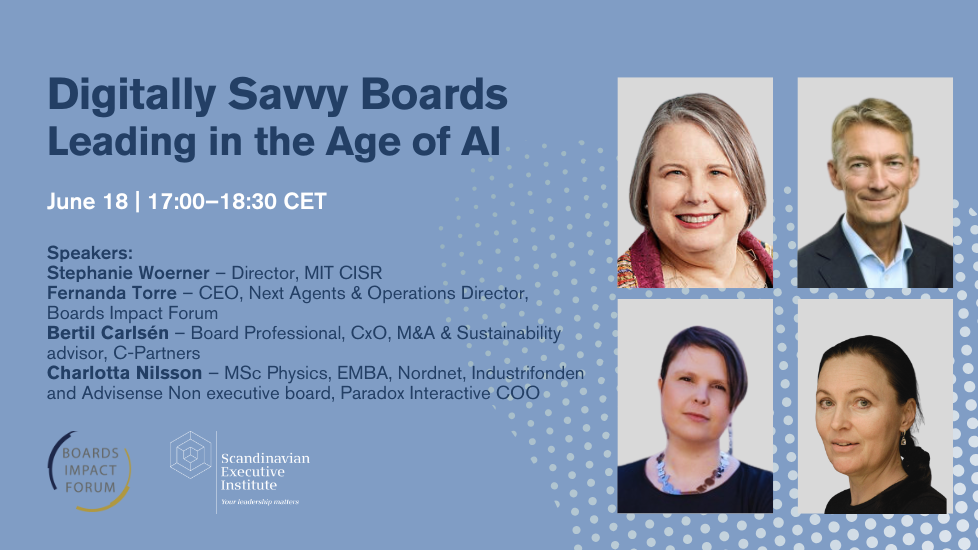
Join the upcoming webinar on “Digitally and AI-Savvy Boards for Sustainable Value Creation” on June 18 and learn more from Stephanie Woerner, Fernand Torre, Bertil Carlsén and Charlotta Nilsson.
Read More and Sign up > HERE
References
- MIT Centre for Information Systems Research, CISR
- MIT Sloan. (2023).These human capabilities complement AI’s shortcomings
- MIT Sloan. (2024).Successful companies now have AI-savvy boards
- MIT Sloan. (2024).Next: Hybrid intelligence systems amplify and augment human capabilities
- Duane, M., & Fisher, D. (2024).SuperShifts: Transforming How We Live, Learn, and Work in the Age of Intelligence
- MIT Sloan. (2024).5 issues to consider as AI reshapes work
- MIT Sloan. (2024).What’s your company’s AI maturity level?
- MIT Sloan. (2024).Climate change and machine learning: The good, the bad, and the unknown
Learn More
At Digoshen, we remain committed to supporting NEDs in this evolving landscape, ensuring AI, sustainability and governance go hand in hand.
Webinars, Peer Exchanges and Events
Check our upcoming events, all with NED Guest Speakers and Peer Exchange:
June 18, 5-6.30 PM CET, Digitally Savvy Boards – Leading in the Age of AI with MIT CICR Academic Director Stephanie Woerner, BIF Operations Director & Research Scientist Fernanda Torre, Chair & NED Bertil Carlse´n and NED Charlotta Nilsson
June 26, 8-9.30 CET, The Future Boardroom – How to Transform in Turbulent Times with Helle Bank Jorgensen, Founder and Director of Board Intelligence, Håkan Broman, Vice Chair Sweish Corporate Governance Code, CEO Swedish Academy of Board Directors and professional NED, and Monica Lagercrantz, Founder and Board Director at Board Clic and international Boardroom advisor.
Board Programs
Sign up for our programs starting in September and October 2025 again:
About Digoshen
This blog post was originally shared at the blog of Digoshen www.digoshen.com, the blog of Boards Impact Forum www.boardsimpactforum.com and the blog of the Digoshen founder www.liselotteengstam.com,
At Digoshen, we work hard to increase #futureinsights and help remove #digitalblindspots and #sustainabilityblindspots. We believe that Companies, Boards, and Business Leadership Teams need to understand more about the future and the digital & sustainable world to fully leverage the potential when bringing their business into the digital & more sustainable age. If you are a board member, consider joining our international board network and master programs.
Welcome to also explore the Digoshen Chatbot on AI Leadership for Boards and Boards Impact Forum, where the Digoshen Founder is the Chair.
Find a link to Digoshen Chair Liselotte Engstam Google Scholar Page
You will find more insights via Digoshen Website, and you are welcome to follow us on LinkedIn Digoshen @ Linkedin and twitter: @digoshen and founder @liseeng