
For the past few years, boards have mostly asked one question about artificial intelligence: how do we control it? That question was reasonable, even necessary. But it is no longer sufficient.
AI is moving from a tool employees use to work faster into something closer to an operational actor — a system that can analyse, recommend, initiate and increasingly execute. As that happens, boards inherit a second responsibility alongside the first. They must govern AI, and also help their organisations imagine what becomes possible because of it.
What could our organisation become — and what future should we help create — as intelligence, agency and decision-making are redistributed between people and machines?
This is also the question at the centre of a Beyond the Old Playbook conversation with Lars Husberg, chairman of three companies operating in very different contexts: is AI primarily something boards need to govern, or an opportunity they need to understand and shape?
From Visible Efficiencies to Strategic Possibility

The painting opening the conversation was Paul Klee’s Twittering Machine (1922), showing bird-like figures wired into a mechanical structure — alive, yet inseparable from the machine they’re part of. A century later, boards face a version of the same difficulty: the line between what an organisation decides and what its systems now decide for it is no longer easy to draw.
Most organisations start where they can see and measure: faster analysis, lower cost, better service. That value is real, but MIT CISR’s research on AI value creation makes an uncomfortable point — adoption itself is no longer the differentiator, since foundation models and agents are available to every competitor on the same terms. Advantage now belongs to whichever companies most effectively connect AI to distinctive customer needs, trusted data and continuous learning. Andrew McAfee’s research at MIT Sloan sharpens this further: the playbook that built durable, decades-long value in the twentieth century doesn’t transfer cleanly to industries where value concentrates fast around whoever is willing to iterate. Durability itself is being redefined.
A narrow lens asks “how can AI help us do this more efficiently?” A strategic one asks: if these capabilities had existed when we designed the company, would we have built the same one?
This calls for foresight rather than prediction — developing a view of where to go, not forecasting a single future. It rests on what the Institute for the Future calls urgent optimism: the belief that the future isn’t predetermined, and that informed action can still shape it.
Redesigning Work Without Losing the Human Centre

None of this is only a technology question. INSEAD’s Phanish Puranam, discussing what he calls OrgTech, argues that the more interesting question isn’t which tasks machines take over, but how technology reshapes the way organisations divide work, coordinate teams and allocate decisions in the first place. In his view, managers may increasingly become teachers — training and developing the people who report to them rather than only monitoring them — alongside a newer, meta-organisational skill: managing the coordination between humans and AI agents, and continually redefining that division of labour.
Puranam is careful to frame this as an addition, not a replacement. As he puts it, the aim is to deploy AI in a way that improves an organisation’s goal-centricity — its profits, efficiency and innovation — without sacrificing its human-centricity. Technology itself is rapidly becoming a commodity available to everyone; what a company differentiates on is its people, and the meaning they find in the work. For a board, that means the question “why are we organising this way” has to keep a genuine account of the human beings inside the answer, not just the metrics.
Becoming a Learning Board

A board cannot govern this well from the outside. It has to become, itself, a learning system — not by acquiring deep technical expertise, but by developing the habit of using AI, comparing what it produces, and noticing where it is genuinely useful and where it quietly narrows the room’s thinking. That means real time set aside for reflection, not only for approval: space to ask which assumptions a recommendation challenged and which it simply reinforced, and what the board would have concluded without it.
This is harder than it sounds, because the same relational habits that make any board work well — trust between directors, the willingness to voice an unpopular view, honest reflection on how the group is actually functioning — are what determine whether AI strengthens a board’s judgment or quietly substitutes for it. A board that already struggles to challenge itself on ordinary matters is unlikely to challenge a fluent, confident AI recommendation either. Becoming a learning board, in that sense, starts with the same human work boards have always needed to do — and only then extends it to the machine.
Staying in Control of What Is Being Built

A board cannot meaningfully oversee a transformation it only encounters through occasional presentations. This is particularly visible with AI, where the technology moves faster than traditional governance cycles — and faster, often, than a board’s own judgment can keep pace with. Harvard Business Review’s research on leadership judgment warns that AI, used carelessly, can train leaders out of the very capacity that gives them an edge: forming an independent view rather than deferring to whatever the model already believes. INSEAD’s research on newer reasoning models raises a subtler version of the same risk — these systems hallucinate less, but are more capable of supporting a wrong conclusion with fluent, entirely convincing logic.
The risk grows as organisations move from generative to agentic AI. When AI only produces a recommendation, a human reviews it before anything happens. An agent can act across systems and make thousands of decisions at machine speed — so boards are no longer overseeing only how people use technology, but where decision rights are being handed to it. The World Economic Forum’s playbook on governing agentic AI is direct about where the real danger sits: rarely a system crashing, more often “hyper-competence applied to a flawed metric“ — a system executing its assigned objective perfectly, and creating a serious problem precisely because it worked exactly as designed.
MIT CISR’s answer is minimum viable governance — not less governance, but governance agile enough to be introduced, adjusted or retired as conditions change, built into the tools themselves rather than gatekeeping placed in front of them. One financial-services case found that a board’s own well-intentioned governance effort ground innovation to a halt within a year, while the shadow use it was meant to prevent crept back in anyway.
This brings us back to Klee’s machine: the organisation is being redesigned before anyone can see the finished result. Boards cannot wait for AI to become certain before deciding which judgment, and which guardrails, to build now.
The defining board question may no longer be “are we governing AI effectively?”
It may be:
are we becoming the kind of board — and building the kind of organisation — capable of shaping what comes next?
Listen to the Conversation
This question is explored further in the Beyond the Old Playbook episode with Lars Husberg.
Lars Husberg shares how boards can govern AI, shaping new opportunities and competitive advantage.
Lars Husberg, chair of three companies and advisor on technology and business transformation, explores whether AI is primarily something boards need to govern-or an opportunity they need to understand and shape. He examines how AI is developing at very different speeds across industries, why boards risk focusing on incremental efficiencies while overlooking larger strategic opportunities, and how foresight, experimentation and continuous learning can help companies act despite uncertainty.
Lars Husberg shares how boards can govern AI while shaping new opportunities and competitive advantage.
Listen to this episode from Exploring Leaders by Digoshen on Spotify.
A conversation with Lars Husberg
 Lars Husberg
Chairman of three companies and also an advisor, whose experience spans technology, digital & sustainability transformation and business leadership. Lars has worked closely with organizations seeking to create value from new technologies while balancing strategic opportunity with responsible implementation.
Connect with Lars Husberg on LinkedIn
From Exploring to Experiencing
Boards Oversight of Responsible AI for Value Creation
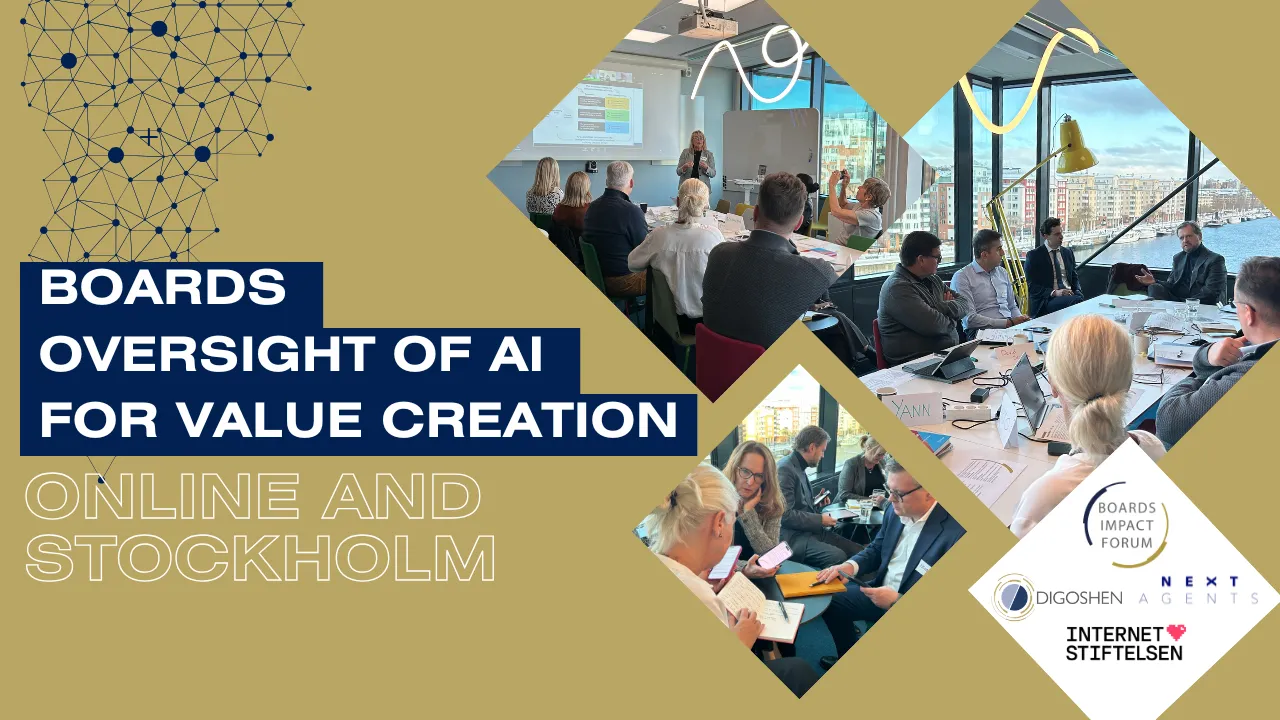
For board members who want to move from reading and discussion to direct experience, the Boards Oversight of Responsible AI for Value Creation — October 2026 Cohort offers a practical learning journey for chairs, non-executive directors, corporate secretaries and senior leaders who want to understand AI from the board’s perspective.
Explore Boards Oversight of Responsible AI for Value Creation
European Boards Growth & Resilience Forum
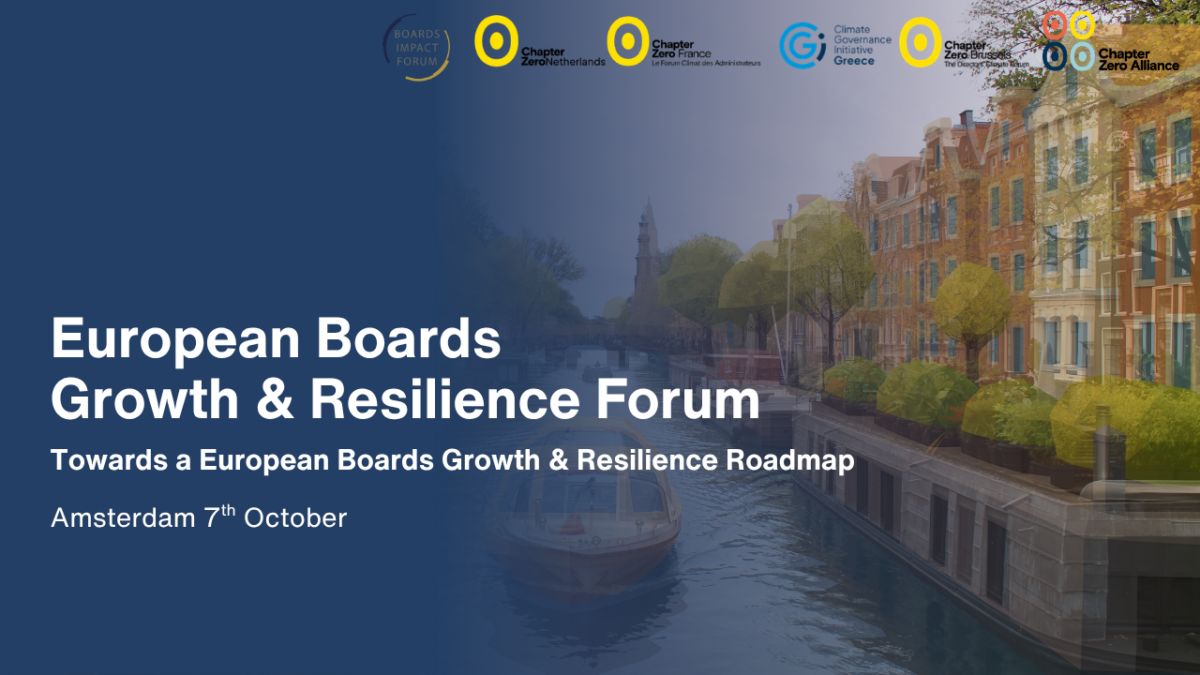
And do you want to meet Lars and other experienced board directors and discuss current and cirtical board questions; On 7 October 2026 in Amsterdam, the European Boards Growth & Resilience Forum brings together non-executive and supervisory directors from across Europe to explore how boards can strengthen European competitiveness, resilience and long-term value creation.
Through confidential peer exchange and working sessions, directors will connect geopolitical shifts, sustainability, AI and technology with the strategic choices facing their companies. Insights from the Forum will also contribute to the European Boards Growth & Resilience Roadmap, planned for publication in early 2027.
Explore the European Boards Growth & Resilience Forum
And do you want to meet Lars and other experienced board directors and discuss current and cirtical board questions
Webinar: The China Factor in Europe’s Competitiveness and Net Zero Transition
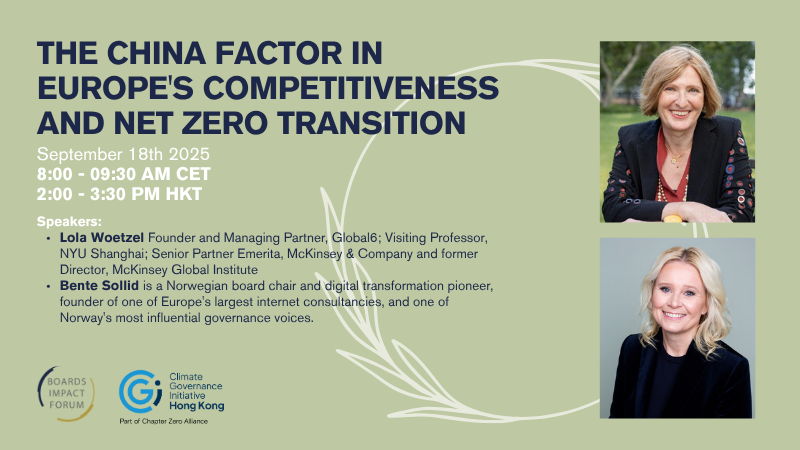
On 18 September 2026, Boards Impact Forum and Climate Governance Initiative Hong Kong Chapter host a webinar exploring how China’s position in green technologies, supply chains and industrial development is shaping European competitiveness, strategic dependencies and the net-zero transition — and what this means for boards.
Explore Further
- Harvard Business Review,AI Is Undermining Leaders’ Judgment. Here’s What to Do About It
- Ethan Mollick, One Useful Thing Blog,Co-Existence and the End of Co-Intelligence
- MIT CISR,Minimum Viable Governance for Generative AI
- MIT CISR,AI Value Creation: Five Provocative Propositions
- MIT Sloan,An MIT Expert on Which Companies Will Succeed in the AI Era
- INSEAD Knowledge,When AI Starts to Think for Itself
- INSEAD Knowledge,How Technology Is Changing the Work of Management
- INSEAD Knowledge,A Revolution in Governance: How AI Will Make Boards More Effective
- INSEAD Knowledge,How Relational Dynamics Affect Boards
- World Economic Forum,From Systems of Record to Systems of Trust: A Board-Level Playbook for Governing Agentic AI
- Institute for the Future,The Lumisphere Experience: The Science of Urgent Optimism
- Stanford Foresight,Playbook for Strategic Foresight and Innovation

This blog post was originally published on the Digoshen blog and the personal blog of Digoshen founder Liselotte Engstam.
At Digoshen, we help leaders and boards navigate an increasingly complex world shaped by AI, digital transformation, sustainability, geopolitical change, and evolving workforce dynamics.
Through research, executive education, thought leadership, coaching, and international networks, we translate emerging trends into practical insights that strengthen leadership, governance, innovation, and long-term value creation. We believe that the future belongs to organizations that successfully combine technological intelligence with human wisdom.
If you are a board member, executive, or leader interested in shaping the future of your organization, we invite you to explore our articles, research, podcasts, learning programs, and international communities.
You are also welcome to discover the Boards Impact Forum, chaired by Digoshen founder Liselotte Engstam, and Novisali, her artistic practice exploring leadership, reflection, and human experience through art.
Find more insights on the Digoshen website, explore Liselotte Engstam’s research on Google Scholar, and follow Digoshen on LinkedIn.