
Why leading through uncertainty requires different questions about risk, judgement and action
Leadership is often described as the ability to make good decisions. Behind that sits a reassuring assumption: gather enough information, analyse the alternatives, manage the risks, and eventually the right answer will emerge.
But many consequential decisions no longer work that way. AI, geopolitics, climate transition, regulation and changing competitive landscapes interact in ways that make probabilities difficult to establish and relationships unstable.
This is also the question at the centre of a Beyond the Old Playbook conversation with Rolf Pfeiffer, experienced business leader, board chair, executive coach and PhD candidate: How do we exercise judgement when every available choice has a downside?
Perhaps leadership under uncertainty is becoming less about finding the right answer and more about knowing what can be analysed, what has to be judged, and when we know enough to act.
From Managing Risk to Navigating Uncertainty
The conversation opens with Wassily Kandinsky’s Composition VIII (1923). Circles, lines, angles and geometric forms pull in different directions, yet somehow form a larger whole. Rolf sees both complexity and movement—an energy carrying the eye towards something still ahead.

It is an evocative image for uncertainty: we can analyse the individual elements, but understanding the whole requires interpretation.
Recent INSEAD research on radical uncertainty makes a similar distinction. Asher Lawson describes situations where relationships between variables are unstable, alternatives cannot readily be compared, and decisions may themselves change the environment. Conventional decision frameworks become less reliable.
This differs from conventional risk, where possible outcomes and probabilities can often be estimated. Risk can often be analysed and managed; uncertainty has to be navigated.
That changes the questions leaders should ask. When uncertainty rises, the instinct is often to seek another forecast, model or expert opinion. Yet the important question is not whether we could know more, but whether knowing more would materially change the decision.
Reversibility matters too. An irreversible acquisition deserves a different threshold of evidence from an experiment that can be adjusted or stopped. And waiting carries risks of its own. INSEAD’s work on boards and disruption highlights how waiting for greater clarity can allow opportunities to disappear.
A more complete decision process therefore considers the risk of acting, the risk of waiting and the risk of doing nothing.
From Either/Or to Both/And
Uncertainty also exposes our tendency to frame difficult tensions as binary choices: growth versus resilience, innovation versus risk, efficiency versus experimentation, short-term versus long-term value.

MIT Sloan’s work on future-ready organisations argues instead for both/and thinking: organisations need to improve efficiency while innovating, deliver today while building tomorrow, and combine discipline with adaptability.
This does not eliminate trade-offs. It changes the question from which side should win? to what is the appropriate balance, and can we redesign the system to make the trade-off less severe?
Instead of innovation versus risk, ask how risk governance can enable responsible experimentation. Instead of growth versus resilience, ask which forms of growth strengthen resilience. Instead of short-term versus long-term value, ask which actions today expand tomorrow’s strategic options.
When the future cannot confidently be predicted, strategy should not simply optimise for one expected outcome. Experiments, scenarios and staged investments can create learning while preserving flexibility. The objective is to build an organisation capable of responding intelligently when its assumptions prove wrong.
From Experience to Judgement
Senior leaders and board members are rightly valued for their experience. Yet uncertainty creates a paradox: the more different the future becomes from the past, the less certain we can be that yesterday’s experience provides the right pattern for tomorrow’s decision.

Senior leaders and board members are rightly valued for their experience. Yet uncertainty creates a paradox: the more different the future becomes from the past, the less certain we can be that yesterday’s experience provides the right pattern for tomorrow’s decision.
Recent INSEAD work distinguishes between building competence through knowledge and experience and building capacity partly by questioning and unlearning assumptions that no longer fit.
This suggests a useful progression: Experience asks, What have I seen before? Awareness asks, What am I seeing now? Judgement asks, Given the difference, what should we do?
There is also an uncomfortable tension. Stanford research found that leaders expressing uncertainty can be perceived as less competent and effective. Yet changing conditions require greater intellectual humility. Leaders therefore need to combine uncertainty with direction: This is what we know, this is what remains uncertain, this is what we will do now, and this is how we will learn.
AI makes this even more important. Nathan Furr and Leonid Sudakov warn in Harvard Business Review that reliance on AI-generated intelligence may weaken original judgement, particularly breadth of perception and independence of interpretation.
We may therefore face two autopilots: a human one shaped by experience and familiar patterns, and an AI one created when convincing machine-generated interpretations are accepted without sufficient questioning.
The challenge is not human judgement versus AI, or intuition versus analysis. It is understanding where each contributes and where its limits begin. Good judgement knows where analysis ends.
Perhaps the defining leadership capability in an age of uncertainty will not be greater confidence in our answers. It will be knowing what we know, what we do not know, what we can learn—and when we nevertheless know enough to act.
Listen to the Conversation
These questions are explored further in the Beyond the Old Playbook conversation with Rolf Pfeiffer, bringing together perspectives from business leadership, board work, executive coaching and research.
The conversation explores why leaders search for certainty, how to recognise when additional information is no longer improving a decision, how to navigate genuine trade-offs, and what distinguishes judgement from analytical decision-making. It leaves leaders and boards with a deceptively simple question:
Which decision might you be postponing because you are still hoping for an option without a downside?
On Youtube:
Rolf Pfeiffer, business leader, board chair & executive coach, on how leaders can exercise judgement
Rolf Pfeiffer, experienced business leader, board chair, executive coach and PhD candidate, explores how leaders can exercise judgement when every available choice has a downside. Drawing on leadership experience, research, and art, he examines why we search for certainty, how to navigate genuine trade-offs, when to stop analysing and start acting, and why awareness and reflection can matter as much as experience.
On Spotify:
Rolf Pfeiffer, business leader, board chair and executive coach, shares how leaders can exercise judgement when there is no perfect choice.
Listen to this episode from Exploring Leaders by Digoshen on Spotify. Rolf Pfeiffer, experienced business leader, board chair, executive coach and PhD candidate, explores how leaders can exercise judgement when every available choice has a downside.
A Conversation with Rolf Pfeiffer
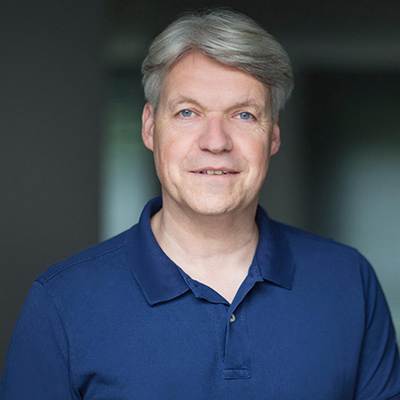
Rolf Pfeiffer is an experienced international business leader, chairman and executive coach. He is co-author of Myprism: Override Your Autopilot, Choose Mindful Leadership, exploring how greater awareness can strengthen leadership and decision-making, and is currently pursuing doctoral research.
Rolf is also a PhD candidate researching how senior executives navigate the transition from full-time executive leadership and craft rewarding post-executive careers—a transition that itself involves choices, trade-offs and uncertainty.
Connect with Rolf Pfeiffer on LinkedIn
From Exploring to Experiencing
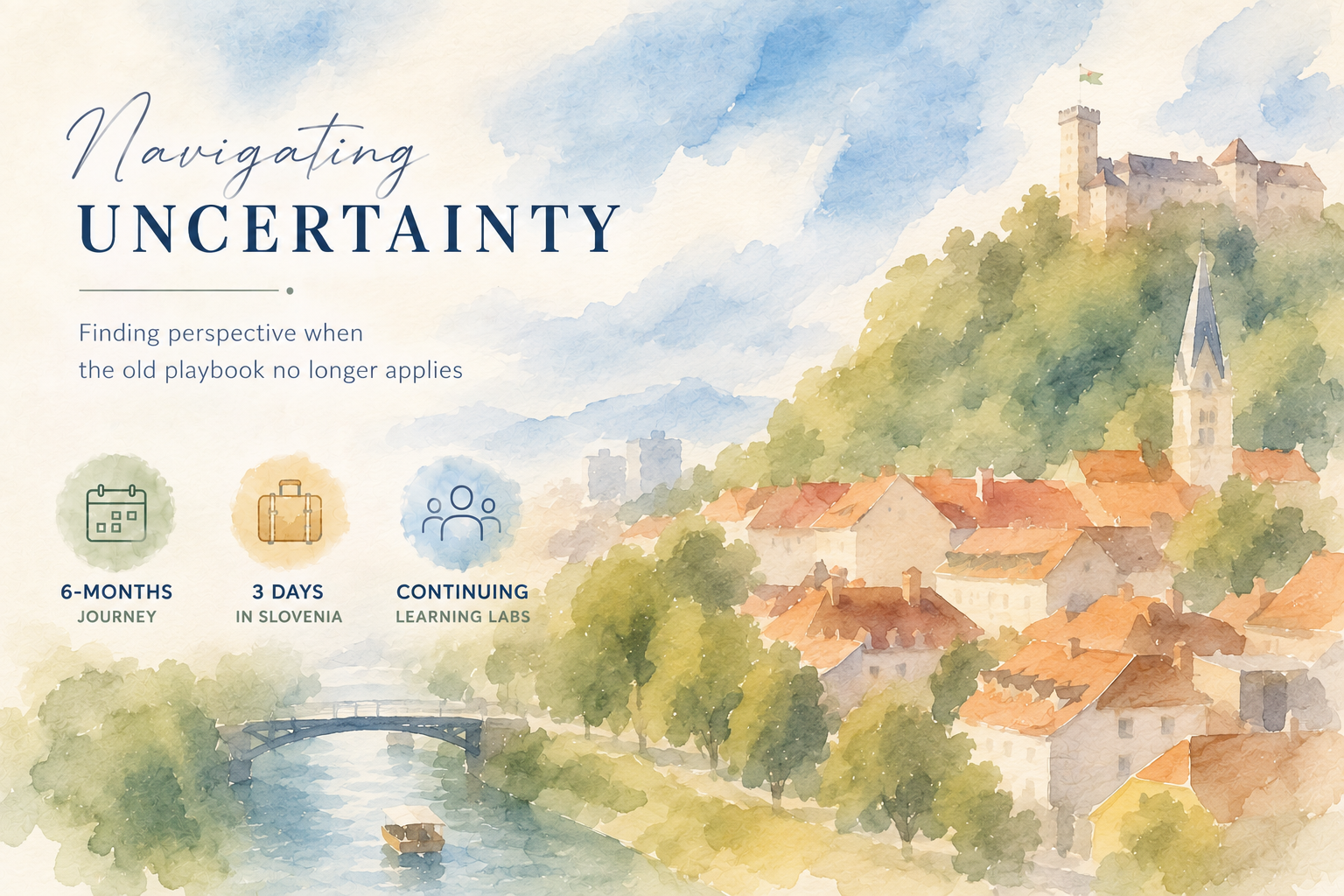
If these questions resonate, Navigating Uncertainty offers an opportunity to explore them more deeply.
This six-month executive learning journey combines coaching, dialogue, art, place and reflection to strengthen four distinctly human capabilities for uncertain environments: seeing, reframing, adapting and renewing.
Explore Navigating Uncertainty and the 2026–2027 cohort
European Boards Growth & Resilience Forum
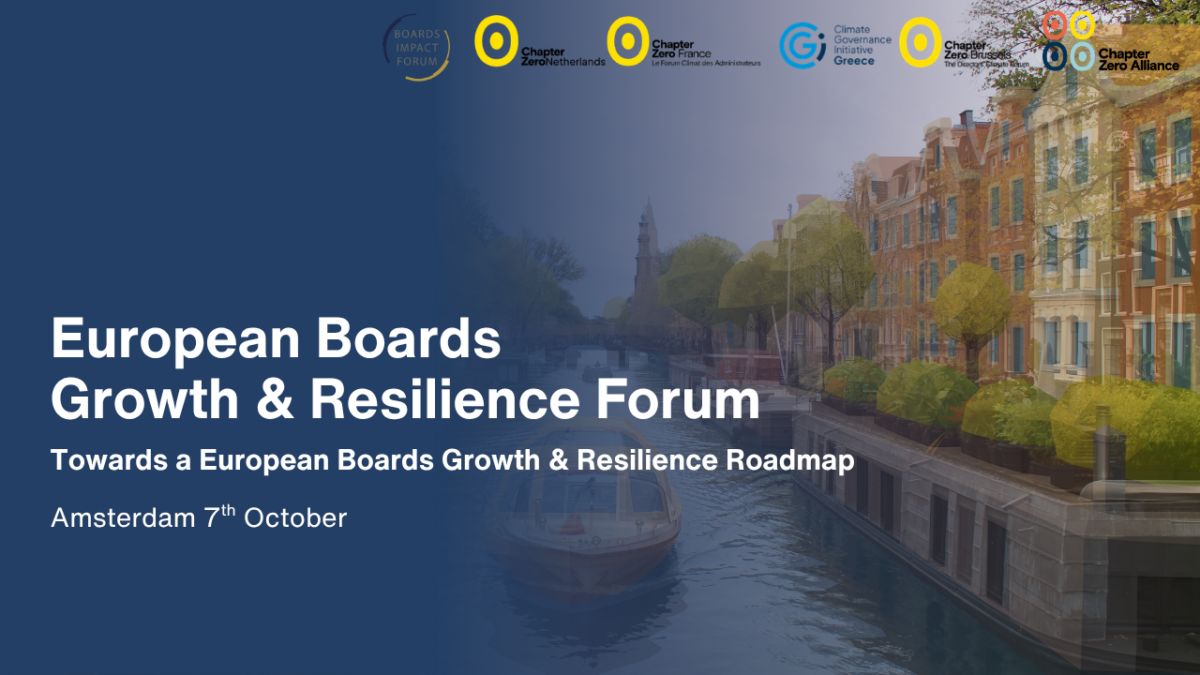
And do you want to meet Lars and other experienced board directors and discuss current and cirtical board questions; On 7 October 2026 in Amsterdam, the European Boards Growth & Resilience Forum brings together non-executive and supervisory directors from across Europe to explore how boards can strengthen European competitiveness, resilience and long-term value creation.
Through confidential peer exchange and working sessions, directors will connect geopolitical shifts, sustainability, AI and technology with the strategic choices facing their companies. Insights from the Forum will also contribute to the European Boards Growth & Resilience Roadmap, planned for publication in early 2027.
Explore the European Boards Growth & Resilience Forum
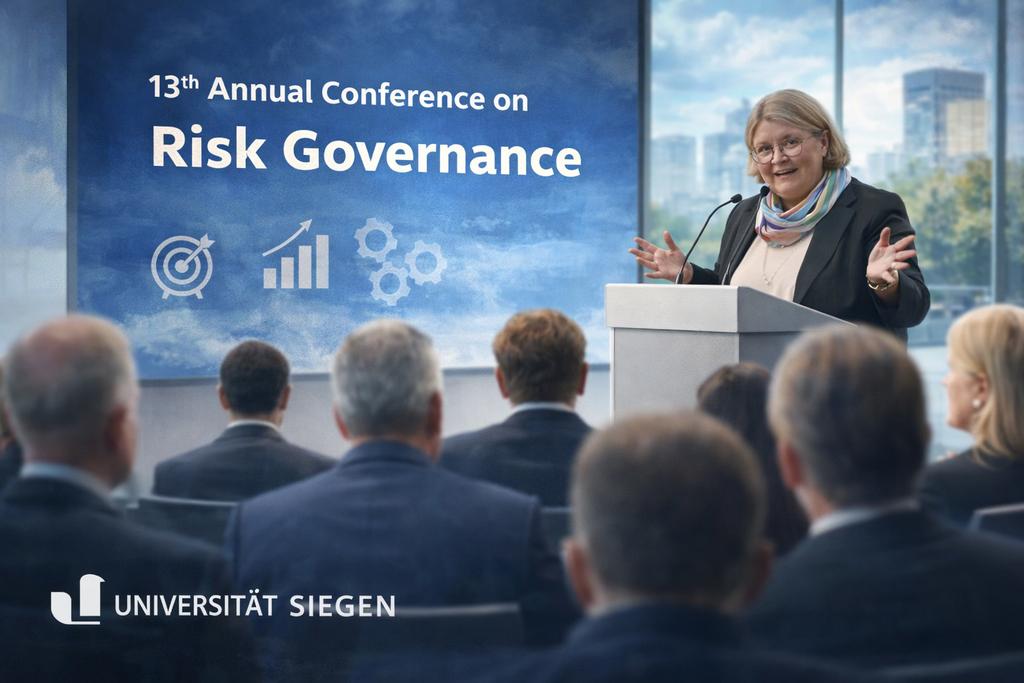
Explore Annual Global Conference on Risk Governance
Explore Further
Asher Lawson, INSEAD — “A Dual Process Theory Perspective on the Role of Radical Uncertainty in Decision Making.”
Read at INSEAD
Ron Soonieus, INSEAD (2024) — “Are Boards Forward-Thinking Enough in this Disruption Era?”
Read at INSEAD Knowledge
MIT Sloan (2025) — “How to Lead Future-Ready Organizations in Times of Uncertainty.”
Read at MIT Sloan
Stanford Graduate School of Business / The Leadership Quarterly (2025) — “Does Expressing Uncertainty Help or Harm Leaders?”
Read at Stanford GSB
INSEAD / Harvard Business Review (2026) — “To Lead Through Uncertainty, Unlearn Your Assumptions.”
Read at INSEAD Read at HBR
About Digoshen

This blog post was originally published on the Digoshen blog and the personal blog of Digoshen founder Liselotte Engstam.
At Digoshen, we help leaders and boards navigate an increasingly complex world shaped by AI, digital transformation, sustainability, geopolitical change, and evolving workforce dynamics.
Through research, executive education, thought leadership, coaching, and international networks, we translate emerging trends into practical insights that strengthen leadership, governance, innovation, and long-term value creation. We believe that the future belongs to organizations that successfully combine technological intelligence with human wisdom.
If you are a board member, executive, or leader interested in shaping the future of your organization, we invite you to explore our articles, research, podcasts, learning programs, and international communities.
You are also welcome to discover the Boards Impact Forum, chaired by Digoshen founder Liselotte Engstam, and Novisali, her artistic practice exploring leadership, reflection, and human experience through art.
Find more insights on the Digoshen website, explore Liselotte Engstam’s research on Google Scholar, and follow Digoshen on LinkedIn.