
We are living through a profound inflection point for global business — a moment where technological acceleration, demographic change, geopolitical uncertainty, and rising societal expectations converge into a level of complexity that challenges the very foundations of leadership.
Viewed through the most recent research from INSEAD, McKinsey, and our own work on AI Leadership for Corporate Boards, one truth becomes clear: organizations today are not simply navigating change; they are navigating multiple overlapping transformations that demand a fundamentally different model of leadership, strategy, and governance.
The companies that succeed in this new era are not those that predict the future most accurately. They are those that build the capabilities, structures, and cultures to continuously reinvent themselves — with AI, with people, and with purpose.
A New Landscape of Complexity

A defining insight from the Global Talent Competitiveness Index (GTCI) 2025) is that the global talent system is under historic stress. The report shows a widening imbalance between the skills required for economic competitiveness and those available in the workforce. Countries and companies alike struggle to find AI engineers, cybersecurity specialists, cloud architects, digital designers, and green-transition experts. These shortages are not temporary. They represent a structural shift that determines which economies will thrive and which will fall behind.
Yet perhaps the most urgent finding is that most organizations still lack a comprehensive strategic workforce plan. Many companies cannot clearly articulate which roles will expand, which will shrink, which new capabilities must be developed, or how many people require retraining over the next three to five years. Without strategic foresight, training becomes reactive, mobility becomes fragmented, and employees lack clarity about their future. In such conditions, organizations risk an avoidable rise in layoffs simply because they did not design pathways for transition.
These challenges are particularly visible in Europe. The region performs strongly in traditional education, scientific research, and technical skills, yet struggles to convert these advantages into sustained competitiveness. Europe lags behind in digital fluency, entrepreneurial capability, and the ability to scale AI-related innovation at speed. Despite world-class universities and deep engineering expertise, European economies move more slowly in translating research excellence into market-ready solutions. The pathway from scientific discovery to commercial impact remains fragmented across countries, sectors, and funding systems. As a result, Europe has many of the right foundational skills, but not enough of the adaptive, cross-functional, AI-era skills that modern competitiveness requires — nor the agile systems needed to redeploy talent quickly and at scale.
What emerges is a region rich in capability but constrained by slow strategic cycles, insufficient workforce foresight, and innovation ecosystems that do not yet match the pace and cohesion of global competitors. Complexity becomes more punishing in systems that move too slowly. This makes leadership — and especially board-level leadership — more decisive than ever. In the era now emerging, the ability to sense, anticipate, and prepare for workforce and capability shifts will determine not only organisational resilience, but the competitive position of entire economies.
Creative Destruction: Understanding the Economic Forces Shaping the Decade

To understand today’s complexity, INSEAD’s Rethinking Capitalism: The Power of Creative Destruction provides a crucial lens. Grounded in the work of 2025 Nobel Laureate INSEAD Professor Philippe Aghion, it explains the underlying engine of economic transformation. Creative destruction describes the constant cycle in which new technologies and business models displace older ones. This process is not only inevitable — it is the primary driver of rising productivity and long-term prosperity.
What makes Aghion’s work so timely is that we are entering a period where creative destruction is accelerating. AI, automation, digital platforms, and green technologies are simultaneously reshaping value chains, redistributing competitive advantage, and redrawing industry boundaries. During such periods, companies face a choice: adapt to the emerging wave of innovation or remain anchored in legacy models that will eventually erode.
Aghion’s insight is that societies do not automatically benefit from creative destruction. They benefit only if they have the institutions, policies, and safeguards that enable the transition — including investment in education, mobility, innovation ecosystems, and workforce transition. The same applies to companies: they must design internal systems that absorb disruption, channel it into renewal, and support people through the transition.
For leaders, acknowledging the inevitability of creative destruction is not enough. They must build the internal capabilities — and the organizational courage — to embrace it
Innovation Execution: The New Industrial Paradigm

If creative destruction explains why organizations must transform, McKinsey’s Innovation Execution: A New Industrial Paradigm Emerges explains how. This research reveals that we are moving beyond the traditional model of innovation as a slow, linear journey from research to development, to prototype, to manufacturing, and finally to scale. For decades, innovation and execution lived in different parts of the organization.
The new paradigm integrates them into a unified system.
In leading companies, R&D, data science, AI engineering, design, manufacturing, operations, and supply chain no longer work sequentially or in silos. They operate in parallel, connected through digital twins, simulation tools, real-time data flows, and AI-driven decision support. Innovation becomes an always-on capability embedded into the operating model itself. Organizations move from idea to prototype to manufacturing readiness with unprecedented speed, precision, and cost efficiency.
This shift challenges the traditional strengths of incumbents. Legacy structures, long planning cycles, fragmented accountability, and siloed cultures slow the pace of reinvention. Meanwhile, digital-native and AI-first companies can scale innovations rapidly, supported by modular technology architectures and fluid cross-functional collaboration. For incumbents, staying competitive requires rebuilding their operating systems — not just their strategies.
Boards must adapt as well. Innovation execution becomes a governance concern. Boards must understand how innovation is funded, how quickly ideas scale, how talent is deployed across the value chain, and how AI shifts the economics of product development and operations.
AI: A Strategic Inflection Point for Leadership

AI now sits at the intersection of strategy, governance, innovation, and workforce transformation. McKinsey’s State of AI 2025 report shows that AI is moving from a set of isolated use cases into the architecture of the enterprise. AI agents plan multi-step tasks, coordinate workflows, identify anomalies, simulate scenarios, generate code, and support strategic decision-making. They operate not as tools but as collaborators — augmenting human judgment and shaping choices.
This raises new leadership questions. AI transforms the economics of competition: decisions become faster, insights become richer, and execution becomes more precise. But it also transforms the architecture of responsibility. Leaders must clarify how decisions are made, which decisions remain human-led, and how AI’s recommendations are validated. Governance frameworks must evolve in parallel with technological capability.
Recent insights from McKinsey reinforce the scale of the shift underway: today’s technologies already make it possible to automate activities representing as much as 57 percent of current work hours, yet more than 70 percent of today’s skills remain relevant — they simply evolve in how and where they are used. This is not a story of machines replacing people, but of new skill partnerships where AI agents and robots take on routine or data-heavy tasks, while humans step deeper into judgment, creativity, empathy, and orchestration. The organizations that outperform will be those that redesign work around hybrid human–machine workflows, invest in AI fluency across all roles, and ensure leaders can guide this shift with clarity, ethics, and purpose. Leadership and governance have become the true bottlenecks — and the true leverage points — in realising the promise of AI.
One of the most consequential insights from all referenced research is that AI is transforming far more jobs than it eliminates. The future of work is defined by redesign, not replacement. Yet without strategic workforce planning — and without investment in new skills — organizations will miss the chance to redeploy talent and instead face unnecessary layoffs. This is not an AI failure. It is a leadership failure.
Boards must treat workforce transition with the same seriousness as capital allocation, risk oversight, and financial planning. Future capability is now a strategic asset, not simply an HR topic.
Dynamic Leadership Capabilities: What Boards and Executives Must Build

Our academic research, both done inclduing collaboration with INSEAD, on Dynamic Board Capabilities, research offers a powerful framework for how boards must operate in this era: through sensing, pivoting, and aligning.
Sensing requires boards and executives to actively look beyond quarterly timelines and traditional markets. It demands curiosity, intentional scanning, AI-supported foresight, and an ability to detect early signals across technology, regulation, customer behavior, and societal expectations. Leaders who sense well anticipate disruption before it arrives.
Pivoting is the ability to act on what is sensed. It requires reallocating capital, talent, and attention toward new opportunities while withdrawing resources from legacy areas — even when those areas still appear profitable. Pivoting is where courage meets discipline.
Aligning ensures that strategy, culture, talent, technology, and risk oversight move coherently. Organizations often fail not because of poor strategy but because of misalignment. Culture pushes in one direction, incentive structures push in another, risk governance in a third.
For boards, these capabilities must be strengthened, institutionalized, and practiced. And they must be supported by AI-enabled decision-making, not merely passive oversight. Boards that use AI directly — in scenario analysis, preparation, portfolio modeling, and risk assessment — will govern more effectively than boards that do not.
Europe’s Opportunity — and Risk
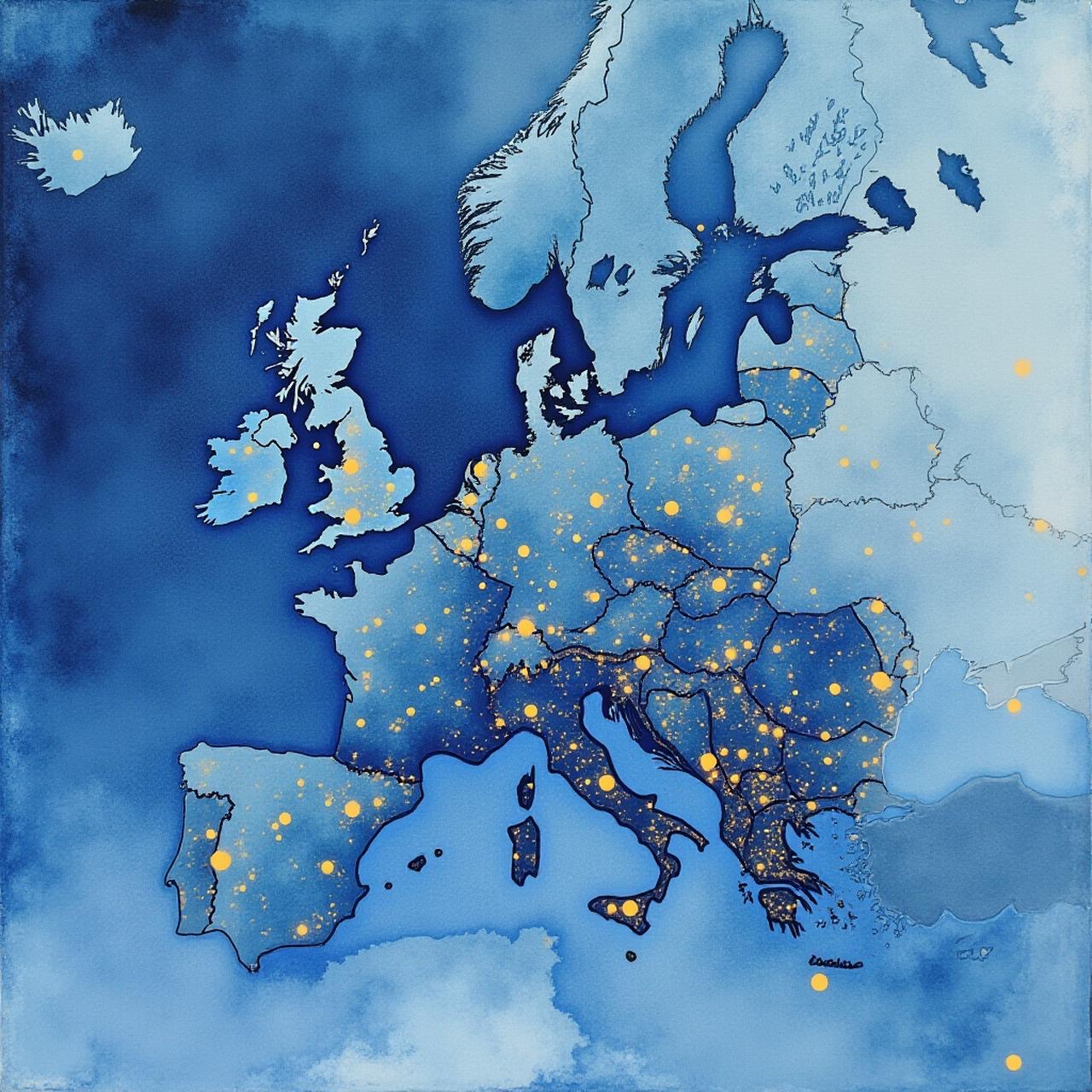
Europe stands at a critical juncture. It leads globally on sustainability, trust, social cohesion, and responsible regulation. It has some of the world’s strongest education systems and most advanced industrial ecosystems. Yet Europe also faces structural disadvantages: fragmented markets, slower scaling, lower technological investment, and governance cultures oriented toward caution rather than speed.
The workforce challenge is particularly urgent. Without comprehensive strategic workforce plans, European companies risk a wave of preventable layoffs, rising talent shortages, and the erosion of innovation capability. But with the right leadership, Europe can define the global standard for human-centered, ethical, and sustainable AI adoption — turning its values into competitive advantage.
The question is whether Europe will move fast enough.
Seven Leadership Imperatives for the Age of Complexity

- Raise strategic ambition on AI and innovation — moving decisively beyond pilots to full-scale business reinvention.
- Industrialize innovation execution — building integrated systems that unify R&D, AI, engineering, design, and operations.
- Shift to skills-based workforce models — creating clear pathways for upskilling, mobility, and professional reinvention.
- Embed AI directly into strategy and governance — including its use within the boardroom and executive decision-making.
- Adopt multi-speed operating models — optimizing today’s performance while simultaneously building tomorrow’s value.
- Strengthen sensing, pivoting, and aligning — the dynamic capabilities that enable continuous reinvention.
- Lead with humanity — emphasizing purpose, ethics, resilience, creativity, and stewardship in an AI-driven world.
Conclusion: Reinvention as the Leadership Currency of Our Time
Business, technology, and transformation have merged into one strategic agenda. The future will belong to leaders who embrace complexity not as a threat, but as a context — who build the capacities to learn faster, adapt faster, and act faster than their competitors.
In an age defined by creative destruction, integrated innovation, and AI-enabled decision-making, the central task of leadership is not to control change but to channel it. Reinvention, grounded in human-centered governance and strategic courage, is the defining imperative.
In this new era, reinvention is not a project. It is a practice. And it has become the ultimate competitive advantage.
Exploring These Questions Further
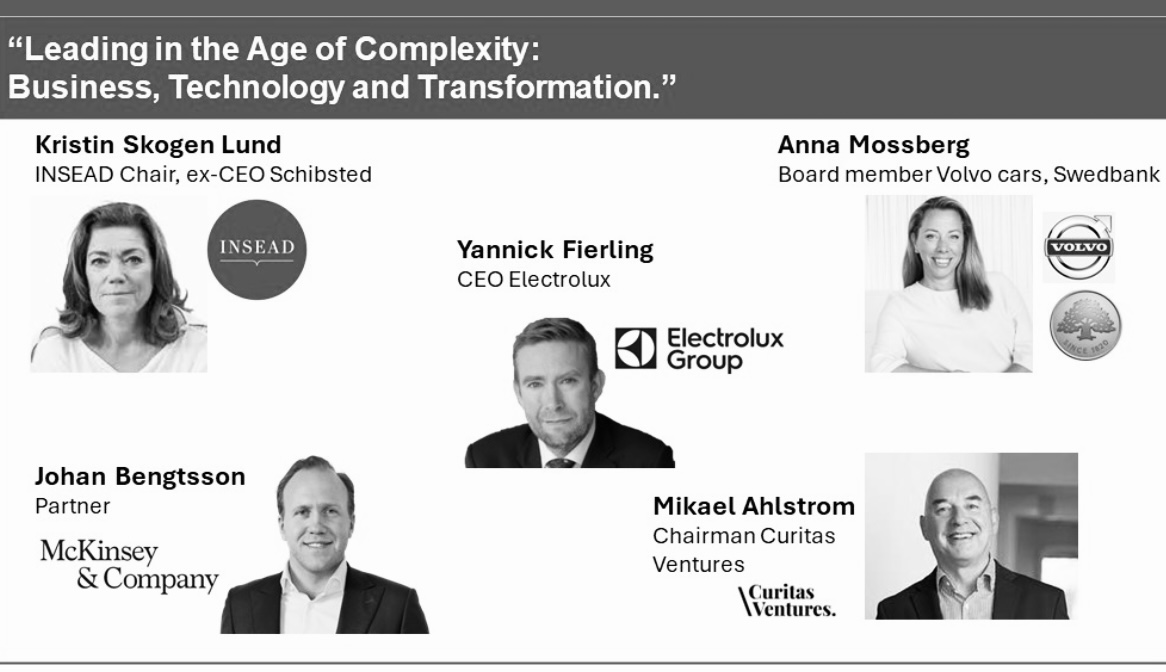
These themes — complexity, competitiveness, innovation execution, workforce transformation, and the evolving role of leadership — will be explored in depth at the upcoming INSEAD Alumni Association Sweden event hosted together with McKinsey on December 1st, 2025, in Stockholm.
Senior leaders from industry, academia, investment, and advisory roles will gather to discuss Leading in the Age of Complexity: Business, Technology and Transformation, bringing together perspectives from CEOs, board directors, private-equity investors, and McKinsey experts.
With keynotes from Kristin Skogen Lund, Chair INSEAD, and Johan Bengtsson, Partner McKinsey, complemented with a strong panel including from contributions from Yannick Fierling, CEO Electrolux, Anna Mossberg, NED at Volvo Cars, Swiszzcom, Swedbak et al, Mikael Ahlström, Experienced PE and VC Investor, Tomas Nauclér, Partner McKinsey, and with facilitation by Liselotte Engstam, Chair Digoshen, Boards Impact Forum et al, the session will examine how Swedish and European organisations can strengthen competitiveness, build innovation capability, develop future-ready talent, and lead responsibly in an era shaped by technology and uncertainty.
The discussion will bridge INSEAD’s latest insights, McKinsey’s research on innovation execution and competitiveness, and practical lessons from leaders operating at the intersection of business transformation, technology, and complexity. Grateful to have co-organized this with my fantastic board colleague Duarte Marchand and the exceptional Henrik Polzer from McKinsey.
This dialogue represents the next step in exploring how leaders and boards can guide organisations through accelerated change — and how Europe can position itself for long-term renewal and competitive strength.
References
INSEAD
- Global Talent Competitive Index 2025 Report
- Rethinking Capitalism: The Power of Creative Destruction, (Based on the work of 2025 Nobel Prize laureate Prof. Philippe Aghion, INSEAD)
- Dynamic Board Capabilities: Developing Board Practices that Impact Corporate Renewal and Performance, (by Engstam, Forzelius, Mangusson KTH, Torre, Van der Heyden INSEAD)
McKinsey & Company
- Innovation Execution: A New Industrial Paradigm Emerges, (McKinsey)
- The State of AI in 2025: Agents, Innovation, and Transformation (McKinsey)
- Agents, Robots and us: Skills partnerships in the age of AI (McKinsey)
Book
- AI Leadership for Corporate Boards – Leading Responsible AI for Value Creation
(Engstam, Torre, Teigland Chalmers, Shekshnia INSEAD, 2025)
Publisher: Springer Nature, Available at Amazon
A December of Reflection Begins

This December, we are opening a quiet doorway each morning: a small poem, an artwork, five guiding words, and three questions to help you slow down and reconnect with what matters.
We move through four themes — Gratitude, Self-Compassion, Purpose, and Transcendence — ending with three days of readiness for the year ahead.
Follow the daily reflections here: https://bit.ly/AdventNovisali

About Digoshen
This blog post was originally shared at the blog of Digoshen www.digoshen.com, and the blog of the Digoshen founder www.liselotteengstam.com,
At Digoshen, we work hard to increase #futureinsights and help remove #digitalblindspots and #sustainabilityblindspots. We believe that Companies, Boards, and Business Leadership Teams need to understand more about the future and the digital & sustainable world to fully leverage the potential when bringing their business into the digital & more sustainable age. If you are a board member, consider joining our international board network and master programs.
Welcome to also explore the Digoshen Chatbot on AI Leadership for Boards and Boards Impact Forum, where the Digoshen Founder is the Chair.
Find a link to Digoshen Chair Liselotte Engstam Google Scholar Page and how the Digoshen Chair have contributed to AI Value Creation.
You will find more insights via Digoshen Website, and you are welcome to follow us on LinkedIn Digoshen @ Linkedin