
Why boards may need to start governing for renewal
Sustainability is now firmly established on many board agendas. Companies measure emissions, assess supply-chain risks, formulate transition plans and prepare increasingly sophisticated disclosures. This represents real progress. But it also raises an uncomfortable question:
Have organisations become better at reporting sustainability than at imagining sustainable businesses?
Reporting asks how well a company is managing its impacts and commitments. Sustainable business development asks something different: where future customer value, innovation, resilience and competitive advantage might come from.
The 2026 IESE survey of boards found that 61 percent of participating companies had integrated sustainability goals and metrics into their business models. Yet placing sustainability on the agenda does not necessarily mean that it is shaping strategy, capital allocation or the search for new business.
Perhaps the next step is not simply to govern sustainability more effectively, but to ask what becomes possible when it is treated as a source of renewal.
This question is also at the centre of a new Beyond the Old Playbook podcast conversation with Chairman and Professor Jaap Winter:
How can boards move sustainability from an obligation to a source of business renewal and competitive advantage?
Seeing the business as a living system
The conversation begins with Gustav Klimt’s Tree of Life, created in 1909. Its roots, branches and spiralling forms extend in different directions, yet everything remains connected as part of one living system.

The image offers an interesting way of thinking about business. Companies often discuss growth, resilience, sustainability and innovation as separate subjects, assigned to different functions or sections of the board agenda. In practice, however, they are deeply interconnected.
A company’s ability to grow depends on the resources it uses, the resilience of its operations, the suppliers and communities around it, the trust it earns and the changing needs of its customers.
Klimt’s tree does not separate growth from the system that sustains it. Growth emerges through the relationships within the whole.
Perhaps sustainability should be understood in the same way—not as a separate branch of strategy, but as one of the lenses through which the whole business is seen.
.
When compliance becomes the frame
The expansion of sustainability regulation, reporting and risk management has been necessary. It has strengthened transparency and made it harder for companies to ignore their environmental and social impacts. But necessary practices can also shape what organisations learn to notice.

When sustainability enters the boardroom primarily through disclosures, targets and regulatory obligations, the discussion can become centred on conformance. Are the required metrics available? Is the company meeting its commitments? Are legal and reputational risks being controlled? These are legitimate questions. The difficulty arises when they define the boundaries of the conversation.
Sustainability may then become a specialist agenda rather than a business question shared by strategy, innovation, operations and commercial leadership. Management becomes skilled at explaining progress against targets, while less time is devoted to exploring how changing resource conditions, customer expectations or technologies could reshape the business itself.
IMD’s sustainability outlook for 2026 describes a landscape influenced not only by climate and regulation, but also by resource security, geopolitics, artificial intelligence and changing industrial economics. These forces affect supply chains, investment choices, customer needs and competitive positions. They cannot be contained within a separate ESG conversation.
The choice is therefore not between compliance and innovation. Compliance establishes an essential foundation. The question is whether boards allow it to become the ceiling of their ambition.
Start with a problem worth solving
One way forward is to begin not with the sustainability target, but with a real customer or business problem.
A 2026 Harvard Business Review discussion about building sustainability strategy around customers makes an important distinction. Sustainability becomes commercially meaningful when it helps solve something customers genuinely experience and value.
Customers rarely buy sustainability in the abstract. They buy lower costs, improved performance, reduced risk, greater trust or a solution that was not previously possible.
A product that uses fewer materials may also be lighter and cheaper to transport. Circular design may reduce waste while giving customers lower lifecycle costs. Greater traceability may improve environmental accountability while also strengthening quality and security of supply.
This changes the starting question. Instead of asking, “How can we make this product more sustainable?”, leaders might ask: How could understanding sustainability help us solve an important customer problem better?
The difference may appear subtle, but it changes the direction of innovation. Sustainability is no longer an attribute added to an existing offer. It becomes a lens for discovering a stronger one.
From obligation to opportunity
The opportunity may also begin elsewhere in the business system. INSEAD research published in 2026 examines companies that created stronger and more sustainable supply chains by working differently with producers and communities. Instead of simply imposing new standards, they invested in training, financing, equipment and long-term relationships.

The results included higher-quality products, more resilient supply chains, stronger customer relationships and, in some cases, premium prices and longer-term contracts. Sustainability created value because the companies connected positive impact with a meaningful business proposition.
Another INSEAD analysis describes how companies confronting European electronic-waste regulation went beyond containing compliance costs. By collaborating across an ecosystem, they helped create a pan-European recycling and compliance business. What began as an obligation became the foundation for new infrastructure, capability and revenue.
Not every regulatory requirement will produce an attractive business. But the first interpretation of a constraint may not be the only one. The strategic question is whether a company is merely absorbing the cost of change or learning something that could also become valuable to others.
Creating tomorrow’s business
Much sustainability work focuses on improving today’s business: using less energy, reducing waste and making operations more efficient. These measures can create meaningful environmental and financial value, but they do not necessarily renew the business.
Renewal begins when sustainability changes what the company offers, how it earns revenue, which capabilities it builds and which ecosystems it joins. Products may become services. Waste may become a resource. A capability developed internally may become something the company can offer to others.

Stanford’s 2026 Sustainability Forum highlighted that many promising solutions struggle not because the invention is absent, but because deployment requires new financing models, partnerships and routes to scale.
This is where boards have an important role. They are not expected to design sustainable products, but they can ensure that the organisation searches for opportunity as seriously as it manages obligation.
That means connecting sustainability with discussions about customers, strategy, innovation and capital allocation. It means examining whether investment is directed only towards meeting commitments or also towards testing future propositions and business models.
It also means accepting that future opportunities rarely arrive with complete financial certainty. Some require bounded experiments, external partnerships and gradual learning. The board’s task is not to approve unbounded ambition, but to ensure that uncertainty is managed through disciplined exploration rather than used as a reason for inaction.
What might grow next?
Klimt’s Tree of Life offers a final reminder. A tree does not grow by reporting the condition of its existing branches. It directs resources towards new growth while remaining connected to the system that sustains it.
The deeper question for boards may therefore not simply be how to make today’s business more sustainable. It may be how sustainability can help the company discover what it should become next.
Where could solving a sustainability problem also solve an important customer problem? Which obligation might create a capability valuable to others? What would sustainability change if it genuinely influenced capital allocation, innovation and business-model choices?
And where might the next branch of the business already be beginning to grow?
Listen to the conversation
In the latest Beyond the Old Playbook conversation, Liselotte Engstam is joined by Jaap Winter to explore how boards can move sustainability beyond reporting, regulation and obligation—and reconnect it with strategy, innovation, business renewal and competitive advantage.
At Youtube
Jaap Winter, board chair & professor, on how boards can turn sustainability into business renewal
Jaap Winter, Chair of the Supervisory Board of Royal Schiphol Group, Partner at Phyleon Leadership & Governance, and Visiting Professor of Corporate Governance at INSEAD, explores how boards can move sustainability from an obligation to a source of business renewal and competitive advantage.
At Spotify
Jaap Winter, board chair & corporate governance professor, on how boards can turn sustainability into business renewal
Listen to this episode from Exploring Leaders by Digoshen on Spotify. Jaap Winter, Chair of the Supervisory Board of Royal Schiphol Group, Partner at Phyleon Leadership & Governance, and Visiting Professor of Corporate Governance at INSEAD, explores how boards can move sustainability from an obligation to a source of business renewal and competitive advantage.
.
A conversation with Jaap Winter
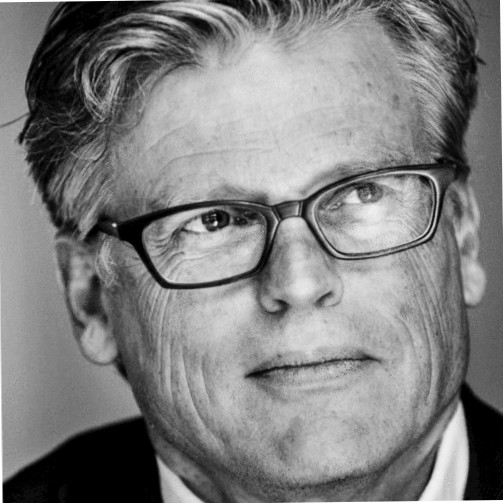
Jaap Winter is Chair of the Supervisory Board of Royal Schiphol Group, Partner at Phyleon Leadership & Governance, and Visiting Professor of Corporate Governance at INSEAD. His work spans corporate governance, leadership and organisational transformation.
.
.
From exploring to experiencing
European Boards Growth & Resilience Forum
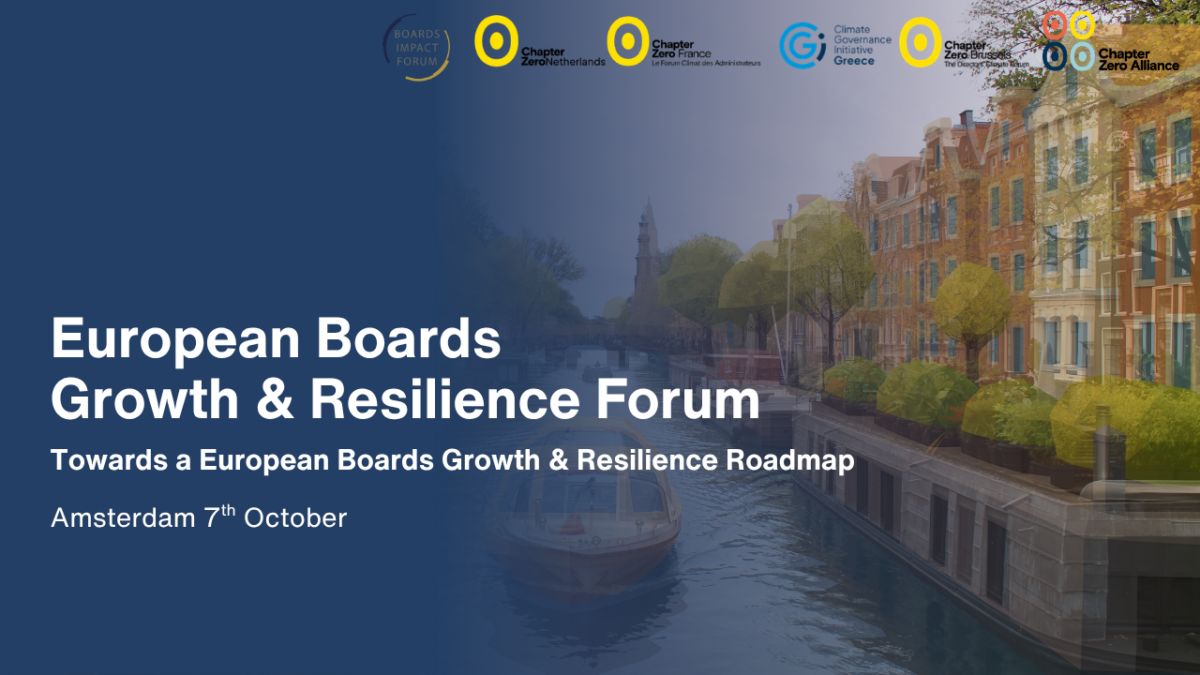
On 7 October 2026 in Amsterdam, the European Boards Growth & Resilience Forum brings together non-executive and supervisory directors from across Europe to explore how boards can strengthen European competitiveness, resilience and long-term value creation.
Through confidential peer exchange and working sessions, directors will connect geopolitical shifts, sustainability, AI and technology with the strategic choices facing their companies. Insights from the Forum will also contribute to the European Boards Growth & Resilience Roadmap, planned for publication in early 2027.
Explore the European Boards Growth & Resilience Forum
Webinar: The China Factor in Europe’s Competitiveness and Net Zero Transition
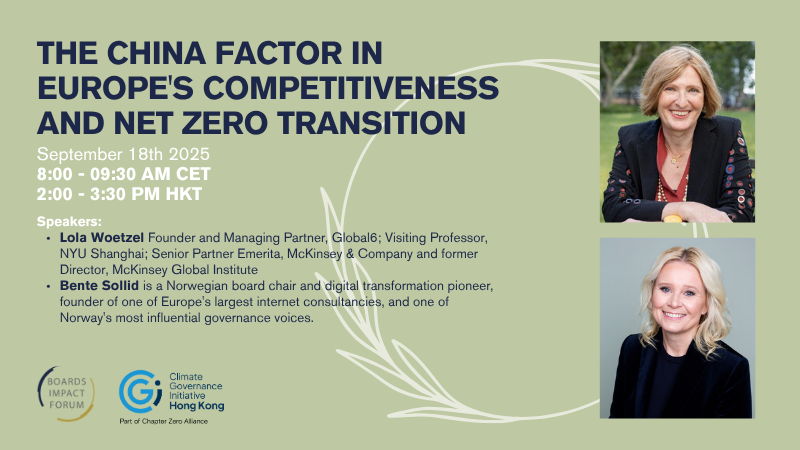
On 18 September 2026, Boards Impact Forum and Climate Governance Initiative Hong Kong Chapter host a webinar exploring how China’s position in green technologies, supply chains and industrial development is shaping European competitiveness, strategic dependencies and the net-zero transition — and what this means for boards.
Navigating Uncertainty Journey
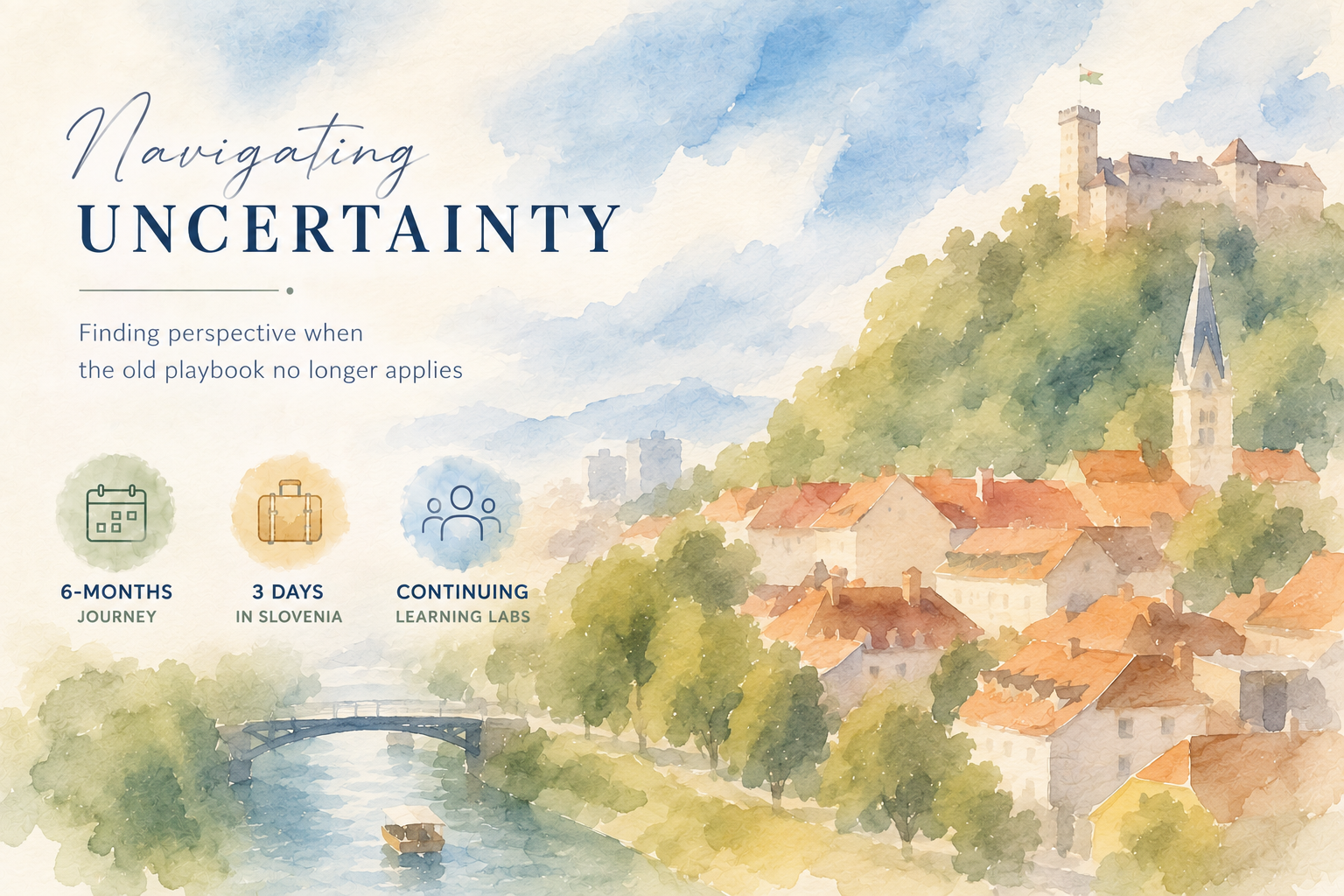
The Navigating Uncertainty — Finding Perspective When the Old Playbook No Longer Applies journey offers an opportunity to create space for these questions. It begins with three immersive days in Ljubljana, 22–24 October 2026, with preparation beforehand. Insights are translated into a Personal Navigation Map of practical experiments, priorities and commitments. The journey then continues through three Learning Labs, providing opportunities to reflect, experiment, adapt and revisit those priorities over the following months.
Explore Navigating Uncertainty and the 2026–2027 cohort
Explore further
Building Value From the Base Up — Amitava Chattopadhyay, INSEAD, 2026. Explores how sustainable supply-chain partnerships can create resilience, differentiation and financial value.
Be an Owl: Turn Sustainability Regulations Into Advantage — Atalay Atasu and Luk Van Wassenhove, INSEAD, 2026. Shows how companies can move beyond compliance and use collaboration and regulation to create new business opportunities.
Building a Sustainability Strategy Around Customers — Harvard Business Review, 2026. Examines how sustainability becomes more commercially meaningful when connected to real customer priorities.
Corporate Governance in a Context of Disruption: 2026 IESE Survey on Boards of Directors — Jordi Canals, Gaizka Ormazabal and Francesc M. Arribas, IESE, 2026. Examines how boards are responding to technological disruption, geopolitical fragmentation, resilience and sustainability.
Sustainability Trends Businesses Must Watch in 2026 — IMD, 2026. Explores how regulation, resource pressures, technology and geopolitical change are reshaping the sustainability agenda for businesses.
Stanford Forum Examines Sustainability Solutions — Stanford Doerr School of Sustainability, 2026. Explores how research, entrepreneurship, new financing models and partnerships can translate sustainability innovations into solutions at scale.
About Digoshen

This blog post was originally published on the Digoshen blog and the personal blog of Digoshen founder Liselotte Engstam.
At Digoshen, we help leaders and boards navigate an increasingly complex world shaped by AI, digital transformation, sustainability, geopolitical change, and evolving workforce dynamics.
Through research, executive education, thought leadership, coaching, and international networks, we translate emerging trends into practical insights that strengthen leadership, governance, innovation, and long-term value creation. We believe that the future belongs to organizations that successfully combine technological intelligence with human wisdom.
If you are a board member, executive, or leader interested in shaping the future of your organization, we invite you to explore our articles, research, podcasts, learning programs, and international communities.
You are also welcome to discover the Boards Impact Forum, chaired by Digoshen founder Liselotte Engstam, and Novisali, her artistic practice exploring leadership, reflection, and human experience through art.
Find more insights on the Digoshen website, explore Liselotte Engstam’s research on Google Scholar, and follow Digoshen on LinkedIn.