
From a defined role to new possibilities for identity, contribution and renewal
What happens when a successful executive career no longer provides the map for what comes next?
After decades of building organisations, leading people and taking on increasing responsibility, the next chapter may not be another full-time executive role. It may become a combination of board work, advisory roles, entrepreneurship, investing, teaching, creative pursuits or other forms of contribution. That freedom can be exhilarating. It can also be surprisingly difficult to navigate.
Research into professional identity, meaning and adult development suggests why. Moving beyond a significant executive role is not simply about deciding what to do next. It can involve reconsidering who we are without the role that has defined us, where our accumulated experience might matter, and how we discover possibilities we cannot yet see.
From a defined role to evolving identities
A major 2026 review by Herminia Ibarra, Sarah Wittman and Kendall Smith describes contemporary careers as increasingly varied, circuitous and characterised by nonlinear transitions.
Their research highlights something important: significant professional change can also involve identity change. Between an established professional identity and whatever comes next, there may be a period in which several possible selves and directions coexist.

For experienced leaders, this makes the transition particularly interesting. After decades as CEO, executive, partner or functional leader, our role may have become intertwined with our identity. Moving beyond it therefore opens deeper questions:
What do I want to carry forward? What am I ready to leave behind? Who might I become next?
The challenge is no longer simply to find the next position. It is to explore a wider field of possibilities.
From the next position to a portfolio of contribution
The Stanford Center on Longevity offers another useful perspective: rather than thinking about the future as replacing one role with another, consider how accumulated assets might be recombined into a broader portfolio. Those assets include much more than financial resources. They include experience, capabilities, relationships, curiosity, resilience, interests and communities we care about.
One person might combine board work with mentoring and investing. Another might mix advisory work, entrepreneurship and teaching. Others may discover entirely new forms of cultural, creative or social contribution.
The important shift is from asking: What should my next job be? to asking: Where could everything I have learned and experienced matter now?
A portfolio does not have to be designed perfectly from the beginning. It can evolve as we experiment, discover what creates energy and meaning, and reconsider where we want to invest our time and attention. citeturn0view1
From achievement to renewed meaning
There is another dimension that conventional career planning can easily overlook. For much of our working lives, organisations provide structures through which we experience progress: titles, responsibilities, teams, objectives, recognition and results. When the dominant executive role changes, some of those familiar markers change too.

A 2025 research review in The Gerontologist examined the role of meaning as people move beyond established working lives. It points towards something financial planning alone cannot address: work can provide identity, purpose, structure and meaningful engagement.
The question therefore becomes not simply how to replace work, but what we want the next phase of life to contain.
For many experienced leaders, “retirement” may be the wrong metaphor altogether.
The more interesting idea may be renewal: reconsidering how experience, relationships, curiosity, time and energy can be invested in ways that remain meaningful.
From planning to experimentation
If the future is genuinely uncertain, trying to design it completely in advance may be the wrong task. Research on professional identity has long highlighted the role of experimentation in discovering possible selves. The 2026 Ibarra review brings this work into the context of today’s increasingly nonlinear careers. This suggests a different approach.
Have the conversation. Try the advisory assignment. Explore a board opportunity. Teach something. Mentor someone. Develop the idea. Enter a new community. Return to a creative interest. Test something that has been sitting at the edge of your professional life.
Some experiments will create energy. Others will not. Both provide information. Rather than trying to predict the perfect destination, we can allow experience to replace assumption.
From familiar perspectives to seeing differently
But experimentation raises another challenge: how do we discover possibilities we have not yet imagined?
Experience is one of a leader’s greatest assets. It gives us judgement and pattern recognition. Yet experience also creates familiar frames through which we interpret the world. Sometimes new possibilities become easier to see when we deliberately step outside those frames. This is where art, place and immersive experiences become interesting.

A 2024 research synthesis examined 31 empirical studies of arts-based leadership development. Across those studies, arts-based approaches were associated with outcomes including reflection and reflexivity, higher-order cognitive capabilities, emotional intelligence and interpersonal competencies. The research also points towards self-discovery and changes in perspective, while recognising that stronger longitudinal evidence is still needed. But the underlying principle can extend beyond art itself.
Change the environment. Slow the pace. Encounter something unfamiliar. Observe before interpreting. Listen to different perspectives. Allow ambiguity before searching for an answer.
These experiences can interrupt familiar patterns of thinking and create room for something different to emerge. Art can do this. So can walking through an unfamiliar city, entering an artist’s studio, experiencing the world through different senses, having an unexpected conversation or simply giving ourselves enough distance from everyday demands to notice what we normally overlook.
Sometimes seeing what comes next begins with seeing differently.
Navigating without a playbook
Taken together, these streams of research suggest that moving beyond a long executive career may require a different way of navigating:
- From a defined role to evolving identities.
- From the next position to a portfolio of contribution.
- From achievement to renewed meaning.
- From planning to experimentation.
- From familiar perspectives to seeing differently.
None requires having the final answer. Perhaps the opportunity is instead to create the conditions in which new answers can emerge.
To step outside the familiar. To become curious again. To explore different possibilities. To experiment in real life. And gradually to discover where experience, relationships, curiosity and energy might matter next.
The next chapter may have no playbook. Perhaps that is precisely what makes it a possibility.
Navigating Uncertainty
These ideas inform Navigating Uncertainty — When the Next Chapter Has No Playbook, a six-month learning journey for experienced leaders moving from a full-time executive career towards a new portfolio of contribution, purpose and possibility.
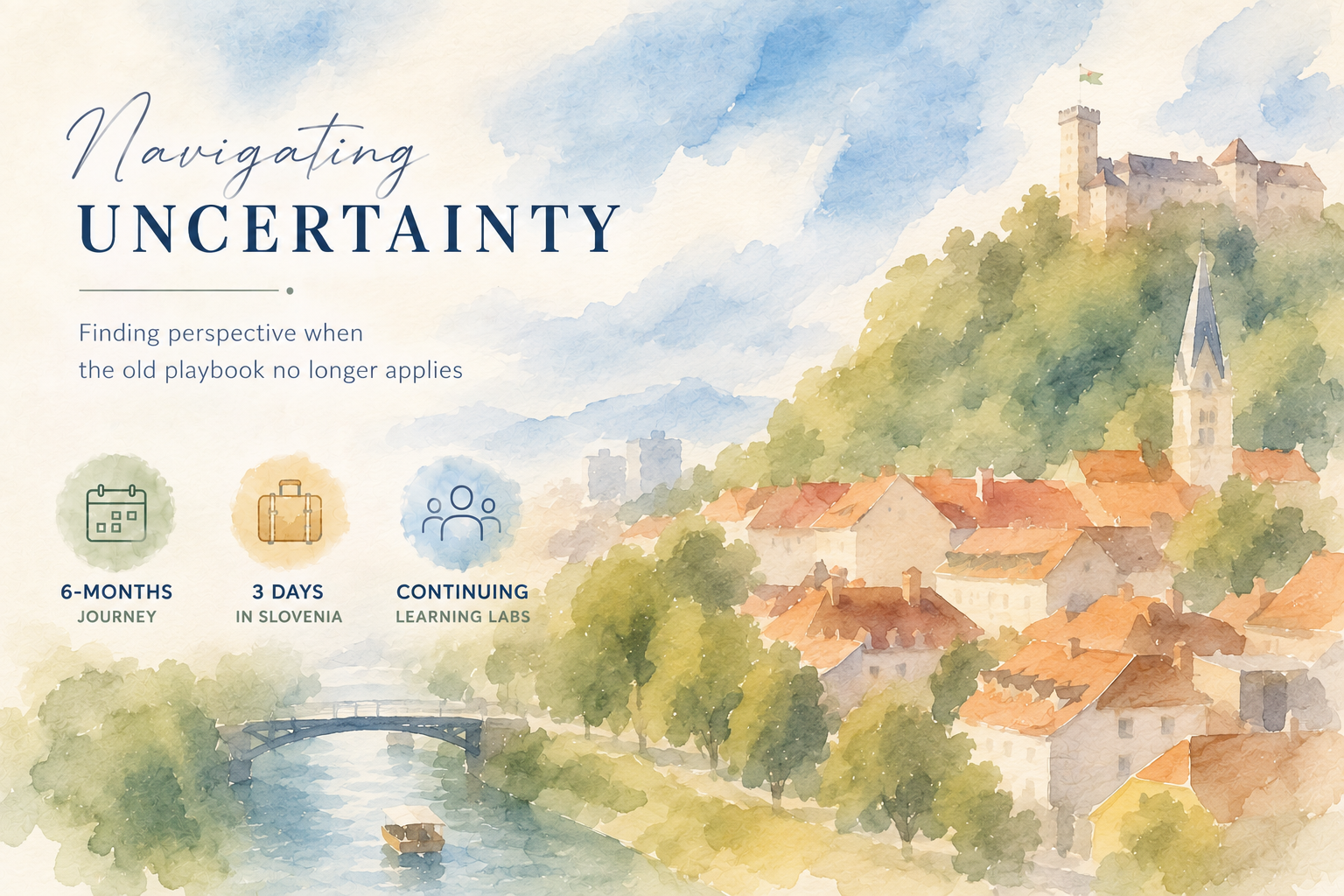
Beginning with three immersive days in Ljubljana, the journey combines place, unusual experiences, art, executive coaching, reflection and peer dialogue. Over the following six months, participants experiment with possibilities and develop a Personal Navigation and Portfolio Map as their next chapter begins to take shape.
The journey is guided by Lidija Drobež and Liselotte Hägertz Engstam, who bring complementary experience in executive and board leadership, executive coaching, transformation and creative practice. Both have first-hand experience of building meaningful portfolios beyond traditional executive careers.
At its heart is a deceptively simple question:
What do I want to do with everything I have learned so far?
22–24 October 2026 | Ljubljana, Slovenia
Explore Navigating Uncertainty
Further Reading
- Professional identity & nonlinear transitions — 2026
Herminia Ibarra, Sarah Wittman & Kendall Smith, Career Transition and Professional Identity: Dynamic Processes, Multiple Selves, and Nonlinear Trajectories, Annual Review of Organizational Psychology and Organizational Behavior.
Read the full Annual Reviews article - Portfolio of contribution / purpose — Stanford Center on Longevity
#RetireRetirement and Build a Purpose Portfolio Instead. This is the source behind the idea of combining and rebalancing different assets, activities and forms of contribution rather than simply replacing one job with another.
Read the Stanford Center on Longevity article - Meaning through the transition beyond full-time work — 2025
The Role of Meaning in the Retirement Transition: Scoping Review, The Gerontologist, Volume 65, Issue 6. This is the systematic research review looking at meaning, meaningful engagement and meaning-making alongside the more conventional focus on financial preparation.
Read the full Oxford Academic article - Arts-based and experiential leadership development — 2024
Berit Sandberg, Outcomes of Art-Based Leadership Development: A Qualitative Metasummary. This synthesises 31 empirical studies and is the research basis for the article’s discussion of reflection, perspective, higher-order cognition and interpersonal development.
Read the full open-access research article
Related Blogposts
About Digoshen

This blog post was originally published on the Digoshen blog and the personal blog of Digoshen founder Liselotte Engstam.
At Digoshen, we help leaders and boards navigate an increasingly complex world shaped by AI, digital transformation, sustainability, geopolitical change, and evolving workforce dynamics.
Through research, executive education, thought leadership, coaching, and international networks, we translate emerging trends into practical insights that strengthen leadership, governance, innovation, and long-term value creation. We believe that the future belongs to organizations that successfully combine technological intelligence with human wisdom.
If you are a board member, executive, or leader interested in shaping the future of your organization, we invite you to explore our articles, research, podcasts, learning programs, and international communities.
You are also welcome to discover the Boards Impact Forum, chaired by Digoshen founder Liselotte Engstam, and Novisali, her artistic practice exploring leadership, reflection, and human experience through art.
Find more insights on the Digoshen website, explore Liselotte Engstam’s research on Google Scholar, and follow Digoshen on LinkedIn.