

The story of Toyota’s andon cord at the Fremont plant is more than a tale of industrial ingenuity. It is a parable for our age. By shifting a single rule—allowing workers to stop the production line when they saw a problem—Toyota transformed a failing factory into one of America’s most productive. The lesson was not about machines, but about dignity: when people are trusted and technology is designed to serve them, performance follows.
Today, boards face a decision no less profound. Artificial intelligence is advancing into every corner of enterprise life. The temptation is to treat it as an inevitability, a tidal wave that must simply be ridden. But history and research show otherwise: technology’s impact depends on the choices leaders make. The question is not whether AI will transform work, but how.
The Architecture of Choice
AI is not a neutral force. Algorithms silently reshape how organizations allocate resources, assign responsibility, and even amplify or silence voices. As one INSEAD study by Professor Puranam argues, algorithms are “hidden governors” of organizational life. Left unchecked, they can deskill, displace, and erode trust. But designed well, they can augment, empower, and create new sources of value.
IMD processr Howard Yu’s Automation Impact Matrix illustrates this fork clearly.
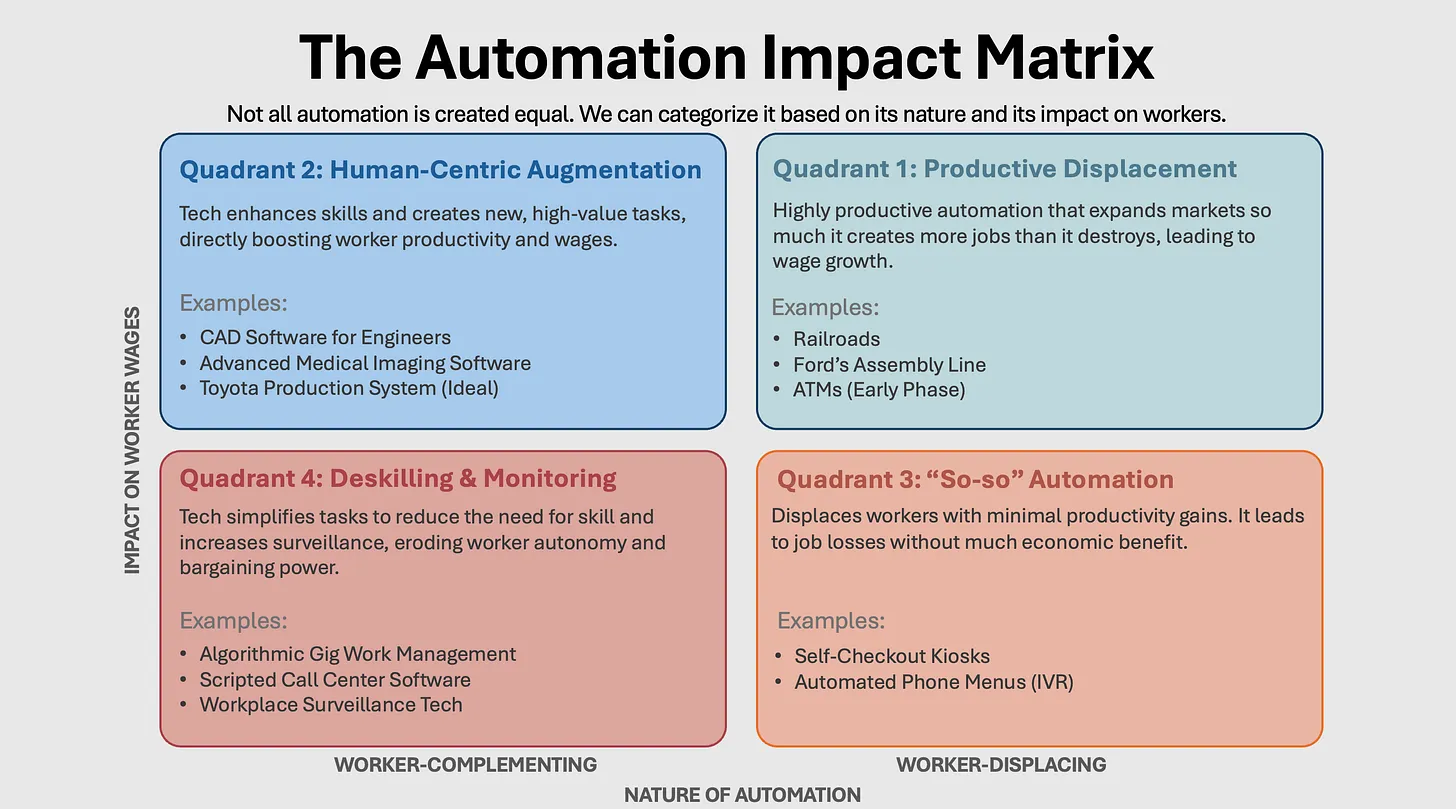
Some technologies complement human skill and create new, higher-value work. Others displace jobs but expand markets in ways that ultimately fuel prosperity. Still others offer the illusion of progress—automating tasks without real productivity gains, or reducing people to monitored cogs. Boards must decide where their companies land on this spectrum.
From Pilots to Purpose and Core Value
The difficulty is not only in choosing the right quadrant, but in scaling AI responsibly. MIT’s CISR research by its Academic Director Stephanie Woerner et al, on enterprise AI maturity shows that most organizations stall at the pilot stage. They test tools in pockets of the business but fail to integrate them into new ways of working. Only those that progress—aligning strategy, modernizing systems, reskilling people, and embedding stewardship—deliver above-industry performance.
Guardian Life and Italgas illustrate this point. Both moved beyond pilots by building interoperable platforms, retraining staff, and creating governance mechanisms for responsible AI. The lesson for boards: scaling is not about more pilots; it is about re-architecting the enterprise around purpose, people, and accountability.
Re-Humanizing the Digital Division of Labor
 This is where INSEAD Professor Phanish Puranam’s idea of re-humanization comes in. Organizations are not only machines for achieving goals; they are also communities that provide meaning, belonging, and growth. The paradox of digitalization is that it can either strengthen or hollow out this human side. Boards must ensure AI augments autonomy, competence, and learning rather than eroding them.
In practice, that means designing a new digital division of labor: algorithms handle what machines do best, while humans do what only humans can—judgment, creativity, empathy, collaboration. The companies that thrive will be “bionic”: places where humans and algorithms amplify each other.
The Board’s Call to Courage
The board’s role is not to approve technology budgets. It is to ask the deeper questions:
- How does AI impact our industry and our business model?
- Does our AI strategy make work more valuable, not less?
- Do our systems and data architectures enable scaling responsibly?
- Are we reskilling and redeploying our people, or quietly discarding them?
- Are our algorithms transparent and accountable enough to earn trust?
Our research on AI Leadership for Corporate Boards shows that boards must hold a dual role: guiding AI’s integration into strategy while supervising its risks. This requires AI fluency across the boardroom—not coding skills, but the ability to probe management with informed, critical questions. Boards must also build dynamic capabilities: sensing the opportunities and threats of AI, pivoting when models or markets shift, and aligning stakeholders to a shared vision of responsible adoption.
Because the future will not be written by algorithms alone. It will be written by boards courageous enough to re-humanize AI—choosing augmentation over erosion, stewardship over drift, and dignity as the foundation of performance.
References
- Yu, H. (2025). The Automation Fork in the Road: Where Does Your AI Path Lead? Forbes, September 2, 2025.
- Torre, F., Engstam, L., Teigland, R., with Shekshnia, S. (November, 2025). AI Leadership for Corporate Boards – Leading Responsible AI for Value Creation. Springer.
- Puranam, P. (2025). Re-Humanize: How to Build Human-Centric Organizations in the Age of Algorithms. Penguin Random House.
- Puranam, P. & colleagues (2024). Organisations in the Age of Algorithms. INSEAD Knowledge.
- Woerner, S. L., Sebastian, I. M., Weill, P., & Káganer, E. (2025). Grow Enterprise AI Maturity for Bottom-Line Impact. MIT CISR Research Briefing, Vol. XXV, No. 8.
Going Deeper: Events and Programs
We are delighted to invite board directors to a series of opportunities to deepen readiness for the AI era:
Exclusive Evening – September 3, Stockholm
An invitation-only gathering dedicated to the future of board leadership in the AI era, generously supported by Internetstiftelsen, Carl Piva, and Jannike Tillå.

Keynote: Stephanie Woerner, Scientist and Academic Director at MIT CISR
Stephanie will share her latest research on how board competencies shape digital transformation and how the definition of digitally savvy boards is evolving in 2025. Drawing on cutting-edge MIT insights and global boardroom practices, she will highlight what truly distinguishes top-performing boards today. We saved some spots for open application.
Apply to join here: Event registration
Deadline: August 29
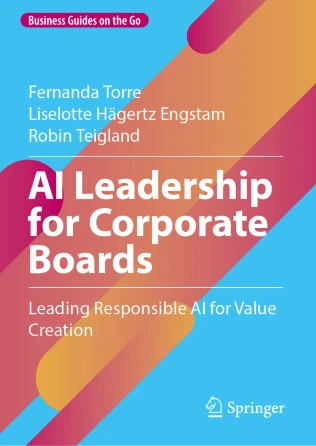
We’ll also give a sneak peek into our upcoming research on Boards’ Leadership of AI, and celebrate the pre-launch of our new Springer book:
AI Leadership for Corporate Boards
by Fernanda Torre, Liselotte Hägertz Engstam, Prof. Robin Teigland (Chalmers), and Prof. Stanislav Shekshnia (INSEAD).
Pre-order here: Springer link
Follow-up Webinar – September 4, 8:00–9:30 CET

AI Leadership Ambition and Transformation
With Professor Mats Magnusson, PhD Candidate Henrik Forzelius, and NED & Chair Tuomas Syrjänen.
(Open to all board directors.)
Register here: Boards Impact Forum
Updated Board Program
.
Board Oversight of Responsible AI for Value Creation
Runs September–October: 4 live sessions + 26 online modules. This research-based training helps board directors strengthen oversight of AI, governance, and sustainability.
Early Bird Extended: Enroll by 31 August to secure €1,900 + VAT (instead of €2,450), or choose the Board Leadership Mastery Bundle (AI + Sustainability) for €2,450 + VAT.
More information and enroll here: Program details
About Digoshen
This blog post was originally shared at the blog of Digoshen www.digoshen.com, the blog of Boards Impact Forum www.boardsimpactforum.com and the blog of the Digoshen founder www.liselotteengstam.com,
At Digoshen, we work hard to increase #futureinsights and help remove #digitalblindspots and #sustainabilityblindspots. We believe that Companies, Boards, and Business Leadership Teams need to understand more about the future and the digital & sustainable world to fully leverage the potential when bringing their business into the digital & more sustainable age. If you are a board member, consider joining our international board network and master programs.
Welcome to also explore the Digoshen Chatbot on AI Leadership for Boards and Boards Impact Forum, where the Digoshen Founder is the Chair.
Find a link to Digoshen Chair Liselotte Engstam Google Scholar Page and how the Digoshen Chair have contributed to AI Value Creation.
You will find more insights via Digoshen Website, and you are welcome to follow us on LinkedIn Digoshen @ Linkedin