
Leadership in the Age of Uncertainty: The Courage to Navigate Complex Futures

In an era of unprecedented global volatility, leaders must develop “geopolitical muscle” and strategic courage to navigate competing scenarios—from regulatory fortress economics to fluid innovation. Success demands balancing bold action with authentic leadership while building organizational and psychological resilience for multiple futures.
The New Reality: When Certainty Is a Luxury We Can’t Afford
We live in what the World Economic Forum calls a period of “unprecedented uncertainty”—marked by geopolitical rifts, regulatory fragmentation, fiscal tightening, and deep technological & AI disruption. The old leadership playbook—waiting for clarity before acting—is no longer viable.
Nearly one-third of global employers anticipate geopolitical tension as a major driver of business transformation by 2030. This isn’t theoretical—it’s rewriting the rules of engagement in real time.
In this landscape, strategic courage is vital—but so is technological literacy. As generative AI becomes more deeply embedded in decision-making, leaders must develop AI literacy: the ability to understand, question, and guide how these technologies are used. Without this, even the boldest decisions risk being misinformed or ethically blind. AI literacy isn’t about coding—it’s about judgement, critical thinking, and responsible innovation.
Four Futures, One Truth: Courage Is Non-Negotiable
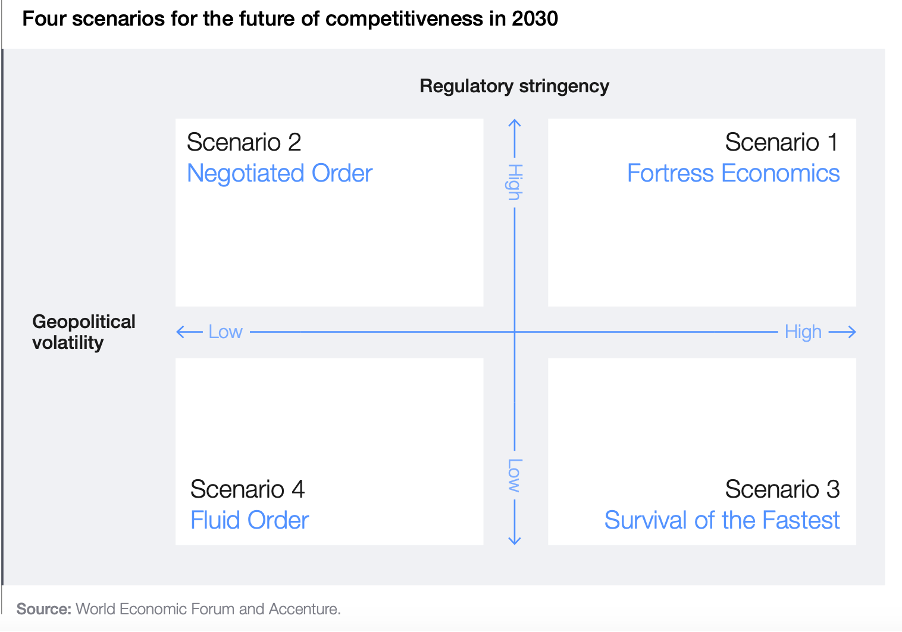
The World Economic Forum’s scenario analysis reveals four potential paths forward, each demanding different leadership capabilities:
Fortress Economics: A world of protectionist competition where the global economy is increasingly shaped by strategic insulation, uncertain alliances and the weaponization of resources, rules and policy tools.
Negotiated Order: Where geopolitical stability and stronger regulatory oversight create a more predictable business environment.
Survival of the Fastest: A volatile environment where lack of institutional safeguards, intensification of strategic competition, fractured markets and compliance gaps drive a “race to the bottom”.
Fluid Order: Where geopolitical stability and reduced regulatory barriers enable rapid innovation, economic dynamism and open competition.
The critical insight? Leaders can’t predict which scenario will unfold, but they can prepare for all of them. The leadership skill that binds them? Strategic courage: the capacity to act decisively despite ambiguity.
Resilience Isn’t a Trait—It’s a Learned Practice
Here’s where psychological insight strengthens strategic leadership. As Maria Konnikova highlights in her review of resilience science, thriving in uncertainty isn’t about personality—it’s about perception, interpretation, and preparation.
“Events are not traumatic until we experience them as traumatic.”
Resilient leaders and boards reframe adversity as challenge, not catastrophe. They cultivate what psychologists call an internal locus of control—a belief that one’s actions shape outcomes. This belief fuels agency, decision-making, and the courage to lead without guarantees.
The Courage Imperative: Fortune Favors the Brave
Research shows that the old adage is true: Fortune favors the brave, not the cautious. Yet in uncertain times, leaders often fall into predictable traps: some freeze, overwhelmed by complexity; others hunker down, hoping to wait out the chaos; many retrench, prioritizing protection over progress.
This defensive mindset is precisely wrong. The companies and leaders who thrive in uncertainty are those who develop what we might call “everyday courage”—the ability to make bold moves consistently, even when the path forward isn’t clear.
Six Pillars of Courageous Board Leadership in Uncertainty

Drawing from cutting-edge governance research and resilience psychology, here’s how leaders build courage as a competitive advantage:
- Develop Dynamic Board Capabilities
Boards must evolve from oversight to guidance—able to sense, pivot, and align without full visibility. This means embracing uncertainty as a working condition, not a temporary disruption. - Ask Better Questions, Set Principled Boundaries
Instead of demanding certainty, boards should focus on asking better questions and setting principled boundaries. The resilient mindset replaces “What’s our plan?” with:
What must we not do?
What values will we not compromise?
Where do we draw the line when the terrain is unclear? This shift fosters ethical clarity, not reactive control. - Build Strategic Agility Over Rigid Planning
Rigid plans falter under fog. Instead, resilient organizations nurture anticipatory capacity—they scan weak signals, adjust narratives, and practice cognitive flexibility, a key marker of resilience according to psychological research. - Balance Localization with Global Reach
Resilience is not isolation. It’s flexible connectivity—regionalizing supply chains while preserving global talent and collaboration. Like psychological resilience, it’s about having multiple pathways to success. - Bring Your Best Self, Not Your Whole Self
As resilience expert George Bonanno shows, emotional regulation—not raw exposure—protects others and stabilizes teams. Leaders must curate their presence, offering clarity, not chaos, during turbulence. - Master Compliance as Competitive Advantage
Resilient leaders view regulatory pressure not as constraint but as a capability to cultivate. AI-driven compliance, ethical guardrails, and stakeholder alignment are sources of strategic advantage in most future scenarios.
Boards as Uncertainty Absorbers
Boards equipped with dynamic capabilities become “uncertainty absorbers”—providing leadership teams with the clarity and confidence to act amid chaos. This includes:
- Reframing uncertainty as manageable challenge
- Replacing perfectionism with adaptive experimentation
- Aligning around long-term value, not short-term metrics
As Konnikova’s insights affirm, resilience is not born—it’s built. And boards can become architects of that capability.
The Distributed Leadership Imperative
The future doesn’t need solo heroes—it needs shared capacity. Asking “Who leads AI?” is the wrong question. The right one is: How do we embed courageous, resilient decision-making at every level?
That means:
- Training people in reframing techniques
- Rewarding intelligent risk-taking
- Creating space for safe-to-fail experiments
Change Resilience in the AI Age
Just 26% of firms achieve value from AI. Why? Because while tech investment is rising, human adaptation is lagging.
Leaders must:
- Close the interpretation gap between technology and trust
- Build organizational mindsets capable of navigating ambiguity
- Treat resilience as an enterprise-wide muscle, not just a personal trait
Practical Implementation: From Insight to Action

For Immediate Action
- Launch regular geopolitical, tech and regulatory briefings
- Establish cross-functional scenario & Innovation teams
- Practice “small courageous bets” to normalize bold action
For Organizational AI Capability
-
Build AI literacy across leadership layers—from boardrooms to project teams.
-
Encourage experimentation while embedding ethical principles and prompt literacy.
-
Invest in upskilling programs that demystify AI and foster collaboration between humans and machines.
For Strategic Planning
- Shift from annual to quarterly strategic reviews
- Use scenario-based budgeting
- Invest in real-time data + emotional data to spot weak signals early
- Establish clear principles and boundaries that guide decisions when data is incomplete
For Board Governance
- Develop dynamic board capabilities that emphasize guidance over oversight
- Create frameworks for principled decision-making in uncertainty
- Build board competencies in sensing weak signals and emerging shifts
- Establish regular “uncertainty absorption” practices that provide management clarity
For Organizational Culture
- Reward reframing and learning, not perfection
- Create psychological safety for ambiguity
- Build distributed courage—not centralized certainty
Why This Matters Now
The convergence of climate disruption, geopolitical fragmentation, and technological acceleration demands not just better strategies—but braver leaders.
The choice is stark:
🧭 Act with courage amid uncertainty — or
⚠️ Be acted upon by external forces you failed to prepare for.
As Konnikova concludes, resilience isn’t magic. It’s meaning-making. The question isn’t whether you have all the answers—it’s whether you’re ready to lead while still searching for them.
References
Global Economic Futures: Competitiveness in 2030, World Economic Forum (June, 2025)
Resilience in the Boardroom, INSEAD Corporate Governance Centre (August 1, 2025)
Board Dynamic Capabilities: Developing Board Practices that impact Corporate Renewal and Performance, Paper by Digoshen, KTH Royal Inst of Technology and INSEAD (March 20, 2024)
Cultivating Dynamic Board Capabilities for increased value creation, Boards Impact Forum (June 6, 2024)
6 Ways to Practice Everyday Courage, HBR (August 5, 2025)
Now Is the Time for Courage, HBR (September 2025)
A Guide to Building Change Resilience in the Age of AI, HBR (July 29, 2025)
Your AI Strategy Needs More Than a Single Leader, HBR (August 4, 2025)
Why AI Literacy is crucial for safe, inclusive and strategic AI transformation, WEF (July 29, 2025)
How people learn to become resilient, The NewYorker (Februay 11, 2016)
Related blogposts
Learn More
At Digoshen, we remain committed to supporting NEDs in this evolving landscape, ensuring AI, sustainability and governance go hand in hand.
More Webinars, Peer Exchanges and Events
Check our upcoming Events with NED Guest Speakers and Peer Exchange
Board Programs- For Board Members
Sign up for our programs starting in September and October 2025:
Board Programs- For Board Members & Executives
About Digoshen
This blog post was originally shared at the blog of Digoshen www.digoshen.com, the blog of Boards Impact Forum www.boardsimpactforum.com and the blog of the Digoshen founder www.liselotteengstam.com,
At Digoshen, we work hard to increase #futureinsights and help remove #digitalblindspots and #sustainabilityblindspots. We believe that Companies, Boards, and Business Leadership Teams need to understand more about the future and the digital & sustainable world to fully leverage the potential when bringing their business into the digital & more sustainable age. If you are a board member, consider joining our international board network and master programs.
Welcome to also explore the Digoshen Chatbot on AI Leadership for Boards and Boards Impact Forum, where the Digoshen Founder is the Chair.
Find a link to Digoshen Chair Liselotte Engstam Google Scholar Page and how the Digoshen Chair have contributed to AI Value Creation.
You will find more insights via Digoshen Website, and you are welcome to follow us on LinkedIn Digoshen @ Linkedin and twitter: @digoshen and founder @liseeng