

The case method is not only a tool to teach business students—it is a powerful practice for boards and leadership teams.
It offers a structured way to challenge assumptions, surface dissent, and sharpen decision-making—especially when navigating complex system changes such as sustainability and AI.

These practices recently came alive in discussions during board learning visits to Harvard and MIT, illustrating how academic insights can be directly applied to strengthen boardroom work.
In a recent article in his new newsletter the Edge, George Serafeim, Professor at Harvard Business School, illustrates this beautifully through a case on Elon Musk: Should his board grant him more voting power? At first, most leaned “yes.” Then one participant asked: “Why would I give him more? BYD has no Elon Musk, and they’re doing great.”
That single dissent reframed the conversation—from a focus on one visionary leader to a reflection on governance structures and long-term resilience.
Why the Case Method Matters for Boards
The case method works because it forces judgment under uncertainty. It thrives not on consensus, but on respectful friction and the courage to surface alternative viewpoints.

Four dynamics make it especially relevant for boards today:
- Respectful disagreement– friction as a feature, not a bug.
- Sharper thinking– voicing your logic publicly forces clarity.
- Peer learning– insights compound when multiple lenses are tested.
- Self-discovery– lessons stick when you uncover them yourself.
Practical takeaways for the boardroom:
- Make the call before discussion.
- Always require a counterexample.
- Steelman before you critique– rebuild the opposing argument in its strongest form before challenging it.
- Rotate perspectives across functions and board members.
- Leaders and Chair speak last.
- Close with an audit of what changed minds.
The real strength of the case method—and of great board practice—is that it creates space for the dissenting voice that changes the conversation. That is where sharper judgment, better governance, and wiser decisions emerge.
Balancing Innovation and Supervision in the AI Era
Research on Digitally Savvy Boards from MIT CISR, and on AI Leadership for Corporate Boards from Chalmers and INSEAD (in collaboration with Digoshen, Next Agents, and the Boards Impact Forum), echoes these lessons.

Findings are clear:
- Digital- and AI-savvy boards perform betterbecause they understand both the opportunities and risks of transformation.
- Talent and leadership are central to success—boards must ensure leaders combine bold innovation with ethical judgment.
- Oversight of responsible AI is now a fiduciary duty—requiring structures, reporting, and governance to ensure AI creates value responsibly.
Just as in the case method, boards must cultivate the courage to ask tough questions, test assumptions, and balance visionary leadership with disciplined oversight.
Going Deeper: Events and Programs
We are delighted to invite board directors to a series of opportunities to deepen readiness for the AI era:
Exclusive Evening – September 3, Stockholm
An invitation-only gathering dedicated to the future of board leadership in the AI era, generously supported by Internetstiftelsen, Carl Piva, and Jannike Tillå.

Keynote: Stephanie Woerner, Scientist and Academic Director at MIT CISR
Stephanie will share her latest research on how board competencies shape digital transformation and how the definition of digitally savvy boards is evolving in 2025. Drawing on cutting-edge MIT insights and global boardroom practices, she will highlight what truly distinguishes top-performing boards today. We saved some spots for open application.
Apply to join here: Event registration
Deadline: August 29
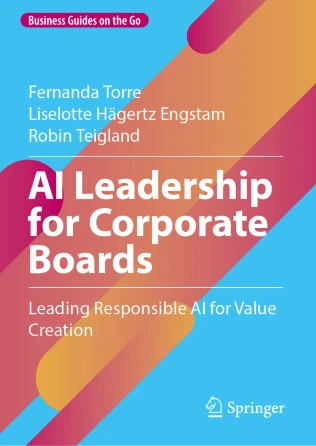
We’ll also give a sneak peek into our upcoming research on Boards’ Leadership of AI, and celebrate the pre-launch of our new Springer book:
AI Leadership for Corporate Boards
by Fernanda Torre, Liselotte Hägertz Engstam, Prof. Robin Teigland (Chalmers), and Prof. Stanislav Shekshnia (INSEAD).
Pre-order here: Springer link
Follow-up Webinar – September 4, 8:00–9:30 CET

AI Leadership Ambition and Transformation
With Professor Mats Magnusson, PhD Candidate Henrik Forzelius, and NED & Chair Tuomas Syrjänen.
(Open to all board directors.)
Register here: Boards Impact Forum
Updated Board Program

.
Board Oversight of Responsible AI for Value Creation
Runs September–October: 4 live sessions + 26 online modules. This research-based training helps board directors strengthen oversight of AI, governance, and sustainability.
Early Bird Extended: Enroll by 31 August to secure €1,900 + VAT (instead of €2,450), or choose the Board Leadership Mastery Bundle (AI + Sustainability) for €2,450 + VAT.
More information and enroll here: Program details
Closing Reflection

Whether in a classroom or a corporate boardroom, the principle is the same: the quality of decisions depends on the courage to welcome dissent, balance boldness with supervision, and continuously learn together.
For boards, this is the path to both responsible oversight and future-shaping leadership in the age of AI.
Further Reading
- The Edge by George Serafeim – Why the Case Method Is Such a Powerful Tool
- What the Case Study Method Really Teaches – Harvard Business Review
- Case Study: Elon Musk – HBS Faculty
- Now Is the Time for Courage – HBR
- How Forward-Thinking Boards Are Using AI – INSEAD Knowledge
- Digitally Savvy Boards – AI Update – MIT Sloan
Earlier blogposts
About Digoshen
This blog post was originally shared at the blog of Digoshen www.digoshen.com, the blog of Boards Impact Forum www.boardsimpactforum.com and the blog of the Digoshen founder www.liselotteengstam.com,
At Digoshen, we work hard to increase #futureinsights and help remove #digitalblindspots and #sustainabilityblindspots. We believe that Companies, Boards, and Business Leadership Teams need to understand more about the future and the digital & sustainable world to fully leverage the potential when bringing their business into the digital & more sustainable age. If you are a board member, consider joining our international board network and master programs.
Welcome to also explore the Digoshen Chatbot on AI Leadership for Boards and Boards Impact Forum, where the Digoshen Founder is the Chair.
Find a link to Digoshen Chair Liselotte Engstam Google Scholar Page and how the Digoshen Chair have contributed to AI Value Creation.
You will find more insights via Digoshen Website, and you are welcome to follow us on LinkedIn Digoshen @ Linkedin